Tuesday morning at devotions, it was announced that the winter term at Hartzell High School will end with early-morning devotions next Tuesday (August 1), one day early because of difficulty making arrangements for buses to Harare, where many Hartzell students live. Suddenly, I was confronted with the reality of the end of my stay at Old Mutare, not a surprise, of course, but always in somewhat distant future, and now I must sort out mixed feelings about that closure. The next few days will include fond good-byes to students who have become friends, listening to those who urgently wish for “pencil friends” (pen pals) in the U. S., collecting letters to be mailed to U. S. addresses, answering the common question, “When will you return?” (usually saying, “At my age, I have no idea.”), and making other necessary end-of-term arrangements. Not least is to fret about whether there will indeed be transport and sufficient petrol for the return trip to Harare on (or before) August 6 when my first flight begins at 1:15 p.m.
These last days will be full of activity as I try to squeeze in as many experiences as possible, like my trip yesterday with Shadreck Mufuti, headmaster of Hartzell Central Primary School. I had the wrong impression that Hartzell Primary, like the high school, is a school that students choose to attend. I learned that it is the only primary school for a large area surrounding Old Mutare and the only choice for children who live as far as 15 km distant. He drove me along roads that children walk daily each way to school and showed me the simple huts and houses where they live, explaining that the poverty of the families living in those homes creates many problems for the children that the school cannot begin to solve. He told me of his great concern for the welfare of those children, many of whom he considers especially vulnerable, and of several dreams he has for improving their condition, hoping I might join him in fulfilling some of those dreams for them. I was touched, hoping too that I might keep alive those concerns once I am far away. Educational tasks are too often thwarted by students' lacks of basic physical needs—food, warm clothing, shoes, medical care—which cannot be ignored but neither can they be easily remedied.
I will leave here next week with a variety of emotions and perceiving that come from the multitude of experiences during more than 13 weeks of living at Old Mutare. It will take a long time, if ever, to sort all of that into reasonable understandings and guidance for my future commitments to this place and these people. I will leave both reluctantly and happily, the latter emotion largely the result of being away from family and often feeling very much alone. The reluctance will come from needing to say good-bye to people whom I have come to respect and appreciate deeply for their dedication and sacrifice to make life better for others. My memories of those heroic people will energize me for a long time. Immediately, I will need to sort through hundreds of pictures and find ways to tell their stories and report my work and impressions. Please, don’t make the mistake of asking me about Old Mutare unless you are willing to hear me out. It will take a big slice of your time.
My first flight leaves Harare for Jo’burg at 1:15 p.m. Sunday, August 6. Early that evening, I will board a plane bound for Washington Dulles, then a hop to Atlanta for my flight to Portland. I will arrive in late afternoon on August 7. Annette will come a day later from Boston. Then, our American life will resume—but never again the same after those months in Old Mutare.
Friday, July 28, 2006


Wednesday, July 12, 2006
Jack of All Trades . . .?
Many of you can add the remaining three words: “master of none.” I feel that way more often than I would like here at Old Mutare as I find myself doing what I would never have expected. Monday’s experience is a good example.
Because this is the two-week mid-year test period for all students at Hartzell High School, I have no teaching obligations there (other than to provide “revising” to a few anxious Form II students whose math test is later this week). So, early yesterday I fired up the 9N Ford, intending to plow a small maize plot at the Children’s Home. I noticed that a slight radiator leak had increased substantially and knew, to my dismay, that the radiator must be repaired. I drove to the Children’s Home (about a kilometer) and informed the director, Peter Mafuti, of our problem. He insisted we get at repairs immediately. It took some figuring out, but within an hour we had dismantled the tractor and removed the radiator, which was soon in the back of his battered station wagon, rattling with us down the road to Mutare. It took some asking and searching, but at last we found a radiator repairman, working at a table in an open yard, who at once located the leak and almost as quickly, repaired it with solder. (I was awed by the speed at which the job had been done; usually, it seems here, such jobs take days of planning and then many more for someone to get around to doing the job.) After a quick lunch--the best french fries I’ve eaten in years--we were on our way back to Old Mutare. Putting the tractor back together took far less time, and it was a great prize when the engine was running with no sign of a leak. By then, however, it was too late to begin plowing, which was postponed until Tuesday, when we first hitched up the mowing machine and chopped maize stalks, and I taught Peter and another workman something about operating the tractor and its machinery. By the time the job was finished, that workman was doing very well on his own, as was the 9N. When we returned to the Children’s Home at the end of the day’s work, we soon had half a dozen boys of various sizes clinging to a perch on the tractor, giggling and chattering in Shona, obviously having a great time, while I kept on warning them about holding on tightly and not falling off as we jolted along the bumpy road.
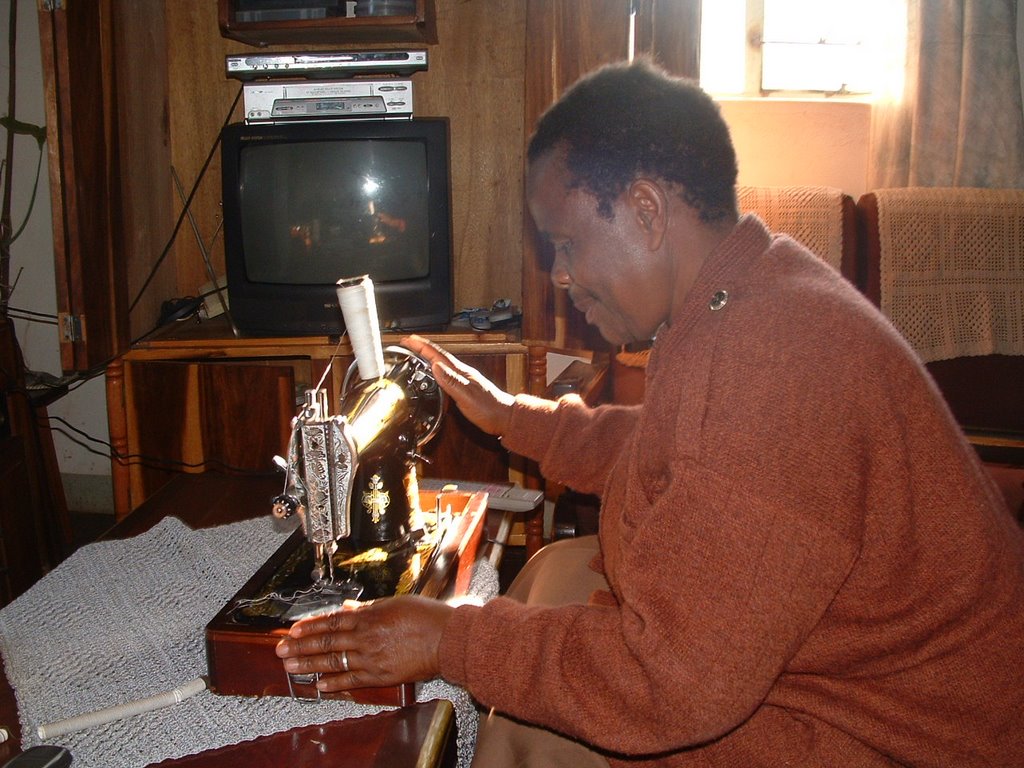
My sewing machine repair business has been booming, begun as an sideline to Annette’s quilting classes when she saw how poorly some machines sewed. I have found there are many impaired and comatose sewing machines in the houses of Old Mutare Mission, and I have been engaged with close to two dozen of them, including seven at the Children’s Home now working well. Early on, I discovered that the usual need is for minor adjustment, of tension or whatever, but the owners imagine I have accomplished great miracles that allow them to sew again. Last Saturday’s experience was exceptionally rewarding. When I saw the machine, I quickly recognized it had been used so long and hard that the hand drive had worn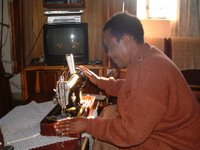 out and become useless. Clearly, this was a machine that meant a great deal to the owner, who must have spent countless hours with it through many years to wear out the drive mechanism. I announced the unhappy verdict that repairs would not be simple, and then she showed me a kit she had bought to electrify the machine. I saw it could be installed easily, and within half an hour, had her sitting at her machine with the new motor making it sew perfectly. I could sense her delight with the results, which was unusually satisfying to me as well.
This morning I led a demonstration class with third graders for teachers at Hartzell Central Primary School. I have taught that third-grade class several times. It seems that the teacher, MaiZvingowanisei, thought so highly of my efforts last week that she reported to the headmaster, who then re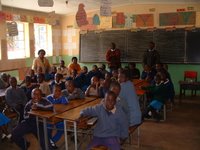 quested a demonstration for other teachers. Although I felt like dismissing the request as so much foolishness, I accepted and later questioned what prompted me to make such a rash decision. I have little difficulty teaching third-grade children, who delight me, but I have no confidence that I can teach teachers, who scare me. Nevertheless, at 10:30 a.m. today I was teaching little kids to multiply sixes and perhaps giving teachers some ideas they can use as well.
Jack of all trades, master of none. As a visiting American, I must exude unusual abilities that may only be fictitious. Those supposed abilities are being tested day by day with, I can only hope, some smidgen of competence.
Because this is the two-week mid-year test period for all students at Hartzell High School, I have no teaching obligations there (other than to provide “revising” to a few anxious Form II students whose math test is later this week). So, early yesterday I fired up the 9N Ford, intending to plow a small maize plot at the Children’s Home. I noticed that a slight radiator leak had increased substantially and knew, to my dismay, that the radiator must be repaired. I drove to the Children’s Home (about a kilometer) and informed the director, Peter Mafuti, of our problem. He insisted we get at repairs immediately. It took some figuring out, but within an hour we had dismantled the tractor and removed the radiator, which was soon in the back of his battered station wagon, rattling with us down the road to Mutare. It took some asking and searching, but at last we found a radiator repairman, working at a table in an open yard, who at once located the leak and almost as quickly, repaired it with solder. (I was awed by the speed at which the job had been done; usually, it seems here, such jobs take days of planning and then many more for someone to get around to doing the job.) After a quick lunch--the best french fries I’ve eaten in years--we were on our way back to Old Mutare. Putting the tractor back together took far less time, and it was a great prize when the engine was running with no sign of a leak. By then, however, it was too late to begin plowing, which was postponed until Tuesday, when we first hitched up the mowing machine and chopped maize stalks, and I taught Peter and another workman something about operating the tractor and its machinery. By the time the job was finished, that workman was doing very well on his own, as was the 9N. When we returned to the Children’s Home at the end of the day’s work, we soon had half a dozen boys of various sizes clinging to a perch on the tractor, giggling and chattering in Shona, obviously having a great time, while I kept on warning them about holding on tightly and not falling off as we jolted along the bumpy road.
My sewing machine repair business has been booming, begun as an sideline to Annette’s quilting classes when she saw how poorly some machines sewed. I have found there are many impaired and comatose sewing machines in the houses of Old Mutare Mission, and I have been engaged with close to two dozen of them, including seven at the Children’s Home now working well. Early on, I discovered that the usual need is for minor adjustment, of tension or whatever, but the owners imagine I have accomplished great miracles that allow them to sew again. Last Saturday’s experience was exceptionally rewarding. When I saw the machine, I quickly recognized it had been used so long and hard that the hand drive had worn
 out and become useless. Clearly, this was a machine that meant a great deal to the owner, who must have spent countless hours with it through many years to wear out the drive mechanism. I announced the unhappy verdict that repairs would not be simple, and then she showed me a kit she had bought to electrify the machine. I saw it could be installed easily, and within half an hour, had her sitting at her machine with the new motor making it sew perfectly. I could sense her delight with the results, which was unusually satisfying to me as well.
This morning I led a demonstration class with third graders for teachers at Hartzell Central Primary School. I have taught that third-grade class several times. It seems that the teacher, MaiZvingowanisei, thought so highly of my efforts last week that she reported to the headmaster, who then re
 quested a demonstration for other teachers. Although I felt like dismissing the request as so much foolishness, I accepted and later questioned what prompted me to make such a rash decision. I have little difficulty teaching third-grade children, who delight me, but I have no confidence that I can teach teachers, who scare me. Nevertheless, at 10:30 a.m. today I was teaching little kids to multiply sixes and perhaps giving teachers some ideas they can use as well.
Jack of all trades, master of none. As a visiting American, I must exude unusual abilities that may only be fictitious. Those supposed abilities are being tested day by day with, I can only hope, some smidgen of competence.
Monday, July 03, 2006
New Experiences at Old Mutare
PURSUING OPPORTUNITIES
Please allow me introduce Tanyaradzwa Magadaire (pronounced mah-gah-dah-EAR-ee). Tanya is 19 years old and a Form VI boarding student at Hartzell High School. Early in our stay at Old Mutare, Tanya introduced himself and let me in on his ambition to study information technology in America and his desire to begin university education in the fall term, 2007. Since then, we have become friends.
Tanya’s home is in Mutare, 15 km from Old Mutare, where his father manages a manufacturing firm and his mother is employed by a company that specializes in school uniforms. He has an older sister and a younger sister who is a Form V student at Hartzell. His family is active in St. Peter’s United Methodist Church, and Tanya is a full member. He attended primary school in Mutare and did his O level (Forms I-IV) as a boarding student at Mutambara High School, also a United Methodist mission school, coming to Hartzell in January 2005 for A-level study. In November, he will take A-level examinations in Maths, Management of Business, and Accounting and has set challenging goals for his achievement. He often sleeps three or four hours early in the night, then studies in his classroom during the remainder of the night.
After he inquired about what is necessary for international students seeking to enrol in a U. S. college or university, I did a search on the Internet and passed on to him information about admission policies and visa requirements. What shook him most was that he must show he has at least $25,000.00 available for his school costs and personal support during one year of study. That much money is far beyond his or his family’s resources. Although he is nowhere near forsaking his dream, he is realizing that the fulfilment may be further into the future than he has hoped.
I tell you Tanya’s story, because his dream is like that of many students who have spoken to me here, yet it will become reality for few. Many face the possibility that after they complete A-level studies, which are intensely demanding, and have passed the gruelling A-level examinations, university study anywhere may be out of the question, costs being well beyond the means of their families. Still, they strive for excellence, knowing that without superior knowledge and high scores, their chances will surely wither. I have been deeply impressed by the determination and dedication of these superior young people.
Perhaps among my friends may be some who will choose to sponsor Tanyaradzwa, or another of these promising students, for a small, or large, part of the first year of American study. Possibly someone has information about scholarships or work/study programs that would trim the cost. I’ll be overjoyed to make the necessary connections and will assure you in advance that you will have the lasting admiration of an exceedingly grateful young person and, truly possible, a rewarding and lasting friendship as well.
PASSING ON SKILLS AND INSPIRATION
Last week, I spent several hours with sewing machines that reside in the houses at Fairfield Children’s Home. Some worked reasonably well, needing only minor adjustments. Three needed significant repairs; one awaits repair parts. This effort was prompted by the request of Cecilia Mabvumbe, an administrator at Fairfield, who was one of the star pupils in Annette’s quilting class and to whom Annette gave added personal instructions that took her further into the quilting process. With the help of Ruth Chimbwanda, our host, MaiMabvumbe wishes to soon begin a quilting class with the mothers of the Children’s Home houses, who are keen to get the class started. Of course, having sewing machines that sew well is essential, and now there are five.
I knew how thrilled Annette would be when she heard that bit of news in our telephone conversation Wednesday. I could detect her delight when she told me to pass on her thanks to Cecilia and Ruth for going on with the project she had begun. Her early intentions are about to come true, and her satisfaction is surely justified.
Another satisfying occurrence last week came about when Joab, one of my Form II students, asked for personal help with math. As we were ending an hour of work, he told me his dream to go into medical work, and then he said, “I want to be like your daughter (pronouncing the word as usual here, daw-TAIR).” Again, I was reminded how valuable one’s presence and influence is here, beyond what we could possibly expect. I am also confident that such influence is hardly possible until we place ourselves where we are closely in touch and open to friendship. I get many reminders of how valuable was Elizabeth and Abby’s visit and their willingness to join freely in the life of this community, and I am hugely grateful for those twelve special days.
BOUNCING ON THE 9N
The 9N Ford tractor is up and going, and what fun we are having with it. Not that the purpose of its donors is our fun, but perhaps they will not deny us our little pleasures. For three weeks, that little tractor has stood silently, because we had assumed the battery was dead. Finally, last Monday, I decided I would go to work on it myself, and I quickly discovered the battery was very much alive. A problem seemed to be that the battery connectors had not been cleaned of corrosion in a great many years. A small amount of cleaning, then tightening the connections securely, quickly showed me that the battery could turn over the engine easily.
However, there was another problem: the ignition key was not available. A little research developed the fact that the headmaster had the key in his possession, and he readily passed it on to me. Then came the defining moment: would the engine actually start running? I turn on the ignition, press the starter, and—Voila!—the engine immediately roars (well, that small engine does not exactly roar) to life. I then jump into the seat—not quite with the alacrity that I probably jumped into the seat 60 years ago—shift into second gear, and I am soon underway, but only for about 10 meters, when the engine dies, most likely, I guess, because its petrol tank is empty. With some help, the tractor is rolled back to its parking place to await the next step.
Petrol is a precious commodity here, usually unavailable, but Peter Mafuto, administrator of Fairfield Children’s Home, has enough us to make another attempt to energize the 9N. He appoints two Fairfield boys to accompany me back a kilometre or so to where the tractor is parked, each carrying one of the small containers with about three liters in each. We quickly pour the fuel into the tractor, and again it starts immediately. The two boys climb on and stand beside me, and we are off on our return trip to Fairfield Children’s Home. At about the half way point, we are met by a dozen of the older children from Fairfield, most wanting to jump on the tractor with us but finally content to run alongside. The tractor is the star as we arrive at the Children’s Home, with a crowd about us to admire it. Peter Mafuto takes his turn driving the tractor around the area before it is returned once again to its secure parking place.
The next development will be to attach some of the machinery that accompanied the tractor across the ocean from America, but that is for another day. Soon, too, I will see to it that all the children at Fairfield who wish to do so will get to ride in a wagon behind the tractor. Then, there will be pictures, and my 9N experiences will be complete.
Please allow me introduce Tanyaradzwa Magadaire (pronounced
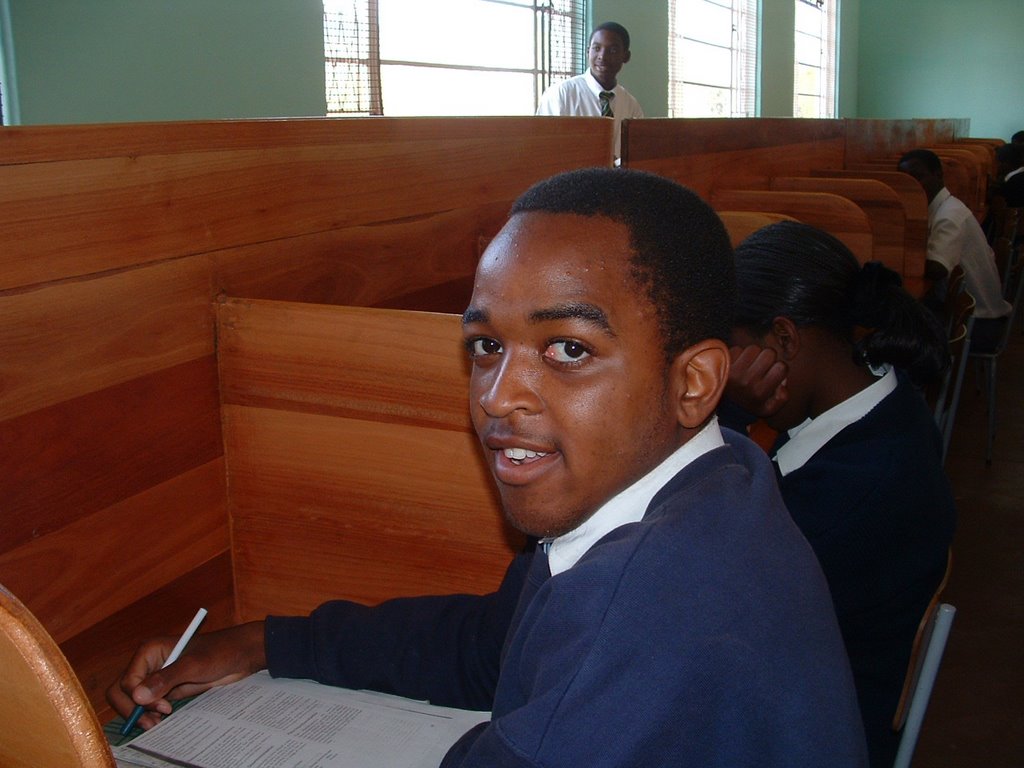 mah-gah-dah-EAR-ee). Tanya is 19 years old and a Form VI boarding student at Hartzell High School. Early in our stay at Old Mutare, Tanya introduced himself and let me in on his ambition to study information technology in America and his desire to begin university education in the fall term, 2007. Since then, we have become friends.
Tanya’s home is in Mutare, 15 km from Old Mutare, where his father manages a manufacturing firm and his mother is employed by a company that specializes in school uniforms. He has an older sister and a younger sister who is a Form V student at Hartzell. His family is active in St. Peter’s United Methodist Church, and Tanya is a full member. He attended primary school in Mutare and did his O level (Forms I-IV) as a boarding student at Mutambara High School, also a United Methodist mission school, coming to Hartzell in January 2005 for A-level study. In November, he will take A-level examinations in Maths, Management of Business, and Accounting and has set challenging goals for his achievement. He often sleeps three or four hours early in the night, then studies in his classroom during the remainder of the night.
After he inquired about what is necessary for international students seeking to enrol in a U. S. college or university, I did a search on the Internet and passed on to him information about admission policies and visa requirements. What shook him most was that he must show he has at least $25,000.00 available for his school costs and personal support during one year of study. That much money is far beyond his or his family’s resources. Although he is nowhere near forsaking his dream, he is realizing that the fulfilment may be further into the future than he has hoped.
I tell you Tanya’s story, because his dream is like that of many students who have spoken to me here, yet it will become reality for few. Many face the possibility that after they complete A-level studies, which are intensely demanding, and have passed the gruelling A-level examinations, university study anywhere may be out of the question, costs being well beyond the means of their families. Still, they strive for excellence, knowing that without superior knowledge and high scores, their chances will surely wither. I have been deeply impressed by the determination and dedication of these superior young people.
Perhaps among my friends may be some who will choose to sponsor Tanyaradzwa, or another of these promising students, for a small, or large, part of the first year of American study. Possibly someone has information about scholarships or work/study programs that would trim the cost. I’ll be overjoyed to make the necessary connections and will assure you in advance that you will have the lasting admiration of an exceedingly grateful young person and, truly possible, a rewarding and lasting friendship as well.
PASSING ON SKILLS AND INSPIRATION
Last week, I spent several hours with sewing machines that reside in the houses at Fairfield Children’s Home. Some worked reasonably well, needing only minor adjustments. Three needed significant repairs; one awaits repair parts. This effort was prompted by the request of Cecilia Mabvumbe, an administrator at Fairfield, who was one of the star pupils in Annette’s quilting class and to whom Annette gave added personal instructions that took her further into the quilting process. With the help of Ruth Chimbwanda, our host, MaiMabvumbe wishes to soon begin a quilting class with the mothers of the Children’s Home houses, who are keen to get the class started. Of course, having sewing machines that sew well is essential, and now there are five.
I knew how thrilled Annette would be when she heard that bit of news in our telephone conversation Wednesday. I could detect her delight when she told me to pass on her thanks to Cecilia and Ruth for going on with the project she had begun. Her early intentions are about to come true, and her satisfaction is surely justified.
Another satisfying occurrence last week came about when Joab, one of my Form II students, asked for personal help with math. As we were ending an hour of work, he told me his dream to go into medical work, and then he said, “I want to be like your daughter (pronouncing the word as usual here, daw-TAIR).” Again, I was reminded how valuable one’s presence and influence is here, beyond what we could possibly expect. I am also confident that such influence is hardly possible until we place ourselves where we are closely in touch and open to friendship. I get many reminders of how valuable was Elizabeth and Abby’s visit and their willingness to join freely in the life of this community, and I am hugely grateful for those twelve special days.
BOUNCING ON THE 9N
The 9N Ford tractor is up and going, and what fun we are having with it. Not that the purpose of its donors is our fun, but perhaps they will not deny us our little pleasures. For three weeks, that little tractor has stood silently, because we had assumed the battery was dead. Finally, last Monday, I decided I would go to work on it myself, and I quickly discovered the battery was very much alive. A problem seemed to be that the battery connectors had not been cleaned of corrosion in a great many years. A small amount of cleaning, then tightening the connections securely, quickly showed me that the battery could turn over the engine easily.
However, there was another problem: the ignition key was not available. A little research developed the fact that the headmaster had the key in his possession, and he readily passed it on to me. Then came the defining moment: would the engine actually start running? I turn on the ignition, press the starter, and—Voila!—the engine immediately roars (well, that small engine does not exactly roar) to life. I then jump into the seat—not quite with the alacrity that I probably jumped into the seat 60 years ago—shift into second gear, and I am soon underway, but only for about 10 meters, when the engine dies, most likely, I guess, because its petrol tank is empty. With some help, the tractor is rolled back to its parking place to await the next step.
Petrol is a precious commodity here, usually unavailable, but Peter Mafuto, administrator of Fairfield Children’s Home, has enough us to make another attempt to energize the 9N. He appoints two Fairfield boys to accompany me back a kilometre or so to where the tractor is parked, each carrying one of the small containers with about three liters in each. We quickly pour the fuel into the tractor, and again it starts immediately. The two boys climb on and stand beside me, and we are off on our return trip to Fairfield Children’s Home. At about the half way point, we are met by a dozen of the older children from Fairfield, most wanting to jump on the tractor with us but finally content to run alongside. The tractor is the star as we arrive at the Children’s Home, with a crowd about us to admire it. Peter Mafuto takes his turn driving the tractor around the area before it is returned once again to its secure parking place.
The next development will be to attach some of the machinery that accompanied the tractor across the ocean from America, but that is for another day. Soon, too, I will see to it that all the children at Fairfield who wish to do so will get to ride in a wagon behind the tractor. Then, there will be pictures, and my 9N experiences will be complete.
Tuesday, June 13, 2006
Family Joys and Sorrow
Yesterday, I said good-bye to Annette, Bizet, and Abby at Harare Intl. Airport, and they were off to Jo’burg and then to Washington, D.C., where they will separate, Annette going to Chicago and to her nursing class reunion on Saturday, Biz and Abby returning to Boston. Biz and Abby arrived in Harare as scheduled May 31 and gave us an outstanding 12 days together. They quickly came to love their host family, the Mudonhis, which includes seven-year-old Anesu (Silas) and three-year-old Ashley. The second day after they arrived, Biz and Abby were hard at work at Old Mutare Hospital, sorting and counting medications, and shortly before their leaving, Biz completed a spreadsheet showing quantities of medications available. She also gave two lectures to A level Biology students at the high school, one on careers in health care and research, and another on the transmission mechanisms of cholera, malaria, HIV-AIDS, and tuberculosis, with much interaction with students in both sessions. Abby quickly became a star with kids of all ages, and she found a keen following among high school students when she worked with me in my classes, and in addition, with quite a few upper level young men. She went home with a stack of names and addresses of students who want to stay in touch. Amid all that activity, we had enough time for leisurely visiting. All in all, it added up to something very special, not least because of the evident appreciation of Old Mutare leaders. Last Friday evening, our family was honored at a festive dinner at the home of the headmaster of Hartzell High School, Mr. Mabvumbe, with many of the local leaders present. The food and hospitality were marvellous, and we were unusually stirred by the kind words addressed to us by people who have become our good friends.
A week ago Saturday, Annette led the third of her quilting workshops with nine women at sewing machines, ardently sewing quilt blocks from strips of colorful material. At the end of the day, those women sang their thanks to Annette, and after words of tribute to her skills and interest in them, they presented her with an elegant, hand painted wall hanging. Although bothered by laryngitis, Annette was obviously very happy and content that her workshops had been successful, measured mostly by the joy of the women who participated. During this past week, she provided additional teaching and patterns to key women whom she feels will most likely pass on their skills to others.
This has been an exciting time around Fairfield Children’s Home. The long-awaited ocean-going container arrived, full of good things packed by Methodist church members in South Carolina. There are dozens of bicycles, much children’s clothing, foods of many kinds, gardening tools, beds, and more, including the center of attention, a 9N Ford tractor beautifully restored to near-mint condition by a group called Tractors for Our Daily Bread in Manhattan, KS. The last 9N came off Ford production lines in 1943, so this has to be an old tractor. When I saw it in the container, I was surprised by a flood of emotion. It is the tractor my dad had on his Iowa farm when our children were young, and I got an instant mental picture of him going about his barnyard chores on that little tractor, one or two kids bouncing on the fender beside him, loving their adventure. I can hardly wait for the opportunity to get into the seat of that tractor, a wagon behind loaded with Fairfield kids enjoying their jaunt as much as my children did 35-40 years ago. There were a few uncertain hours during the process of bringing the container to Old Mutare, notably about customs duties and agricultural inspections. All finally worked out well, the only glitch being the quarantine of all jars of Wal-Mart peanut butter until a test of purity and safety has been completed. Try explaining that to the manager of your favorite Wal-Mart store!
The excitement of the container’s arrival was marred by the passing of one of the Fairfield children. Shingarai had lived in house 7a for two years. His little body had already resisted several serious illnesses, but this time he was unable to fight off an assault by meningitis and pneumonia, and he died in a Harare hospital. His body was brought back for a funeral service and burial at Old Mutare last Monday. It was tremendously touching to walk in the funeral procession between single-file lines of his uniformed schoolmates at Hartzell Central Primary School at the sides of the road, stretching for a hundred meters or more, big and small, standing still and silent as the procession passed by. Shingarai, nine years old, is now added to all those statistics that depict the plight of African children dying of disease treatable in much of the world but here, far too often, a death sentence. He was an orphan; there was no family at his funeral—that too, a picture of reality for increasing numbers of African children.
A week ago Saturday, Annette led the third of her quilting workshops with nine women at sewing machines, ardently sewing quilt blocks from strips of colorful material. At the end of the day, those women sang their thanks to Annette, and after words of tribute to her skills and interest in them, they presented her with an elegant, hand painted wall hanging. Although bothered by laryngitis, Annette was obviously very happy and content that her workshops had been successful, measured mostly by the joy of the women who participated. During this past week, she provided additional teaching and patterns to key women whom she feels will most likely pass on their skills to others.
This has been an exciting time around Fairfield Children’s Home. The long-awaited ocean-going container arrived, full of good things packed by Methodist church members in South Carolina. There are dozens of bicycles, much children’s clothing, foods of many kinds, gardening tools, beds, and more, including the center of attention, a 9N Ford tractor beautifully restored to near-mint condition by a group called Tractors for Our Daily Bread in Manhattan, KS. The last 9N came off Ford production lines in 1943, so this has to be an old tractor. When I saw it in the container, I was surprised by a flood of emotion. It is the tractor my dad had on his Iowa farm when our children were young, and I got an instant mental picture of him going about his barnyard chores on that little tractor, one or two kids bouncing on the fender beside him, loving their adventure. I can hardly wait for the opportunity to get into the seat of that tractor, a wagon behind loaded with Fairfield kids enjoying their jaunt as much as my children did 35-40 years ago. There were a few uncertain hours during the process of bringing the container to Old Mutare, notably about customs duties and agricultural inspections. All finally worked out well, the only glitch being the quarantine of all jars of Wal-Mart peanut butter until a test of purity and safety has been completed. Try explaining that to the manager of your favorite Wal-Mart store!
The excitement of the container’s arrival was marred by the passing of one of the Fairfield children. Shingarai had lived in house 7a for two years. His little body had already resisted several serious illnesses, but this time he was unable to fight off an assault by meningitis and pneumonia, and he died in a Harare hospital. His body was brought back for a funeral service and burial at Old Mutare last Monday. It was tremendously touching to walk in the funeral procession between single-file lines of his uniformed schoolmates at Hartzell Central Primary School at the sides of the road, stretching for a hundred meters or more, big and small, standing still and silent as the procession passed by. Shingarai, nine years old, is now added to all those statistics that depict the plight of African children dying of disease treatable in much of the world but here, far too often, a death sentence. He was an orphan; there was no family at his funeral—that too, a picture of reality for increasing numbers of African children.
Monday, May 29, 2006
“And Africa Will Be Saved”
 Yesterday was a beautiful day at Old Mutare. The sun shone brilliantly in a cloudless sky, and temperatures were in the 60’s and 70’s. MaiChimbwanda, Annette, and I walked the mission road to church quite early to ensure a seat on a busy Sunday morning. The service would be festive, with many visitors. Rev. Daniel Wandabula would be consecrated Bishop of the East Africa Annual Conference of the United Methodist Church, with churches in Sudan, Uganda, Rwanda, and Burundi. Bishops had arrived from Angola, Mozambique, and Zimbabwe, along with many delegates. There was a grand procession of dignitaries into the church, led by two choirs, our own church choir and the choir of Africa University. Our own bishop led the service, which had been supremely well planned and organized. All was in English, with translation via earphones to those whose language is Portuguese. Sadly, one glitch caused difficulty: there was no power. Speakers were forced to use a bull horn to be heard by the more than 2,000 in the congregation. Thankfully, there was no lack of light, as the sun poured in through the large windows. (I can only begin to imagine what would happen in a typical American church if power were out. No organ? No keyboards? No guitars? No projector or sound system? Could worship proceed?)
Music was marvellous. Long before the service began, the high school students began singing informally and continually, ending only when the sound of choirs signalled the onset of the procession. The congregation sang “What a Friend We Have in Jesus,” and “Pass Me Not, O Gentle Savior.” I stopped singing just to listen to the harmony of that great singing congregation. There were several songs by the two choirs, including a setting of “His Eye Is on the Sparrow,” by our church choir, with solo verses sung by the daughter of our headmaster and his wife—not Ethel Waters either in size or power but exquisitely beautiful nonetheless.
The most moving part of the long service—we had been seated before 9:00 a.m. and left the church at noon—was a song by the Africa University Choir. Repeated again and again in the song was the refrain, “The Holy Spirit will come down, and Africa will be saved.” Suddenly, I believed the truth of what was being sung and felt confidence as never before in our Africa pilgrimages.
No day goes by without someone or many speaking about the deprivations of life. I learn of great sacrifices being made to send children to school. I hear of the difficulties of having sufficient food to feed the family and see the hard labor necessary to maintain gardens. I hear of school children who may not have eaten for days. I listen to vigorous, bright high school students dreaming of university education but knowing well that barriers between them and their dreams are enormous. Last week, my 8-year-old friend, Silas Mudonhi, suffered from a bout of malaria. Thankfully, treatment shortened his illness to a few days, but I thought of many children throughout Africa who would be far less fortunate. Many days, I must fight off a pervading gloom.
But suddenly yesterday, I was caught up in the words of a song and embraced by hope. I thought that probably such hope is not so much in the episcopal structures being displayed before us, although strong church leadership will be vital. I thought more of those bright, strong young people seated behind me, students of Hartzell High School, with great potential of mind, spirit, and heart, who, with many like them, are the hope of Africa. Dedicated to following Jesus, they will change their continent. I had no trouble believing that through them, the Holy Spirit will come down, and Africa will be saved. Those words will be my mantra in what remains of my time here.
This Wednesday, we go to Harare to meet Bizet, our daughter, arriving with Abby, our granddaughter. They will have 12 days to experience rural Zimbabwe. We hope it will be as eye-opening and mind-bending for them as it has been for us, who on Wednesday, complete four weeks of our stay. Annette has only two weeks remaining before her trip back to the U. S. with Bizet and Abby. She must then deal with the sadness of ending rich and indispensable relationships. Fortunately, I have two more months to live out those relationships and add to my growing reserve of knowledge and experience. Just one example: last week, two Form II girls stopped me at school to ask if had time to meet them for remedial math. We decided on 9:00 a.m. Saturday. I arrived shortly before 9:00 a.m., unsure whether my two students would appear, knowing that new interests could easily have replaced their concern about math lessons. Promptly at 9:00 a.m., they and a stream of others arrived until the classroom was jammed to the last seat, probably 40 students who then, most of them eagerly, joined in our discussion of solving inequalities. I can only wish that just a few of the world’s inequalities might be solved as simply, but if the dedication of those students is an indicator, it might happen. “The Holy Spirit will come down, and Africa will be saved.”
Monday, May 22, 2006
A BUSY WEEK
Last week was full of activity around the D.S.'s home where we are living. The week before the annual women's (and men's) revival demanded much work by both Givemore and Ruth Chimbwanda, including seeing to the butchering of a "beast" (we would say steer) and handling all of the meat to feed people at the revival. The revival, which took place at Nyakatsapa, about 30 km from Old Mutare, brought thousands of people for the services which began Friday evening and continued until Sunday morning--an all-night program Saturday night. Annette and I attended most of the Saturday program, and I had the incomparable privilege of preaching to the crowd Saturday afternoon shortly after lunch break (when we ate part of the beast), substituting for Abiot Moyo. My sermon, ably interpreted in Shona by Mr. Mukwendiza, a sixth-grade teacher at Hartzell Primary School, was just about the only thing in English the whole time we were there. We recognized few words, but the spirit and power of the gathering was unmistakable, an amazing experience. On our trip back to Old Mutare I was in the back of the pickup with Ed Wentz, a water engineer from North Carolina doing a study of the water supply for Hartzell High School, whose presence will be a very interesting addition to our experience here. Our trip in the darkness, with the clear, starry southern sky above us, was another special time.
Adding to the busyness of last week was the visit of the United Methodist bishop of the Zimbabwe East Annual Conference on Thursday. Everyone around all of the units of Old Mutare got to work cleaning and making the premises beautiful. The bishop visited each unit and pronounced all in topnotch order.
Annette's and my tasks went on somewhat nornally. I am now teaching 13 classes in the weekly schedule, plus spending time at the hospital doing data entry that is far behind. Friday I got the rare privilege of speaking to the Hartzell students, about a thousand of them, in morning devotions. I wish I had words adequate to express the feelings I had looking out into a thousand faces of young people and feeling the magnetism of their acceptance. Annette was at the hospital two days counting pills into little bottles, and she is preparing for the next session of her quilting class this coming Saturday. Tomorrow I will visit a third-grade classroom at Hartzell Primary School and will think about my third-grade friends in Jacksonville, whom I miss greatly. Yesterday's worship service at Old Mutare UM Church was another highlight, as we were among at least 2,000 worshipers, most of them Hartzell boarding students, whose singing is marvelous. We were treated to a dozen or more numbers by a visiting church choir, which in the U. S. would be considered up to professional standards. It was another outstanding experience for us to add to our rapidly-growing collection.
A NOTE TO OUR REGULAR E-MAIL FRIENDS: I have yet to be able to access my Earthlink account and thus do not know if you have written and am unable to send letters. Also, I was counting on regular Earthlink access for my addresses and can remember few. Forgive me, please. I hope to find a computer soon that Earthlink will accept. I am so sorry not to be in direct contact with you. I want you to know that Annette and I well and continually enjoying our close contacts with people who are becoming very special friends.
Adding to the busyness of last week was the visit of the United Methodist bishop of the Zimbabwe East Annual Conference on Thursday. Everyone around all of the units of Old Mutare got to work cleaning and making the premises beautiful. The bishop visited each unit and pronounced all in topnotch order.
Annette's and my tasks went on somewhat nornally. I am now teaching 13 classes in the weekly schedule, plus spending time at the hospital doing data entry that is far behind. Friday I got the rare privilege of speaking to the Hartzell students, about a thousand of them, in morning devotions. I wish I had words adequate to express the feelings I had looking out into a thousand faces of young people and feeling the magnetism of their acceptance. Annette was at the hospital two days counting pills into little bottles, and she is preparing for the next session of her quilting class this coming Saturday. Tomorrow I will visit a third-grade classroom at Hartzell Primary School and will think about my third-grade friends in Jacksonville, whom I miss greatly. Yesterday's worship service at Old Mutare UM Church was another highlight, as we were among at least 2,000 worshipers, most of them Hartzell boarding students, whose singing is marvelous. We were treated to a dozen or more numbers by a visiting church choir, which in the U. S. would be considered up to professional standards. It was another outstanding experience for us to add to our rapidly-growing collection.
A NOTE TO OUR REGULAR E-MAIL FRIENDS: I have yet to be able to access my Earthlink account and thus do not know if you have written and am unable to send letters. Also, I was counting on regular Earthlink access for my addresses and can remember few. Forgive me, please. I hope to find a computer soon that Earthlink will accept. I am so sorry not to be in direct contact with you. I want you to know that Annette and I well and continually enjoying our close contacts with people who are becoming very special friends.
Friday, May 12, 2006
At Home in Old Mutare
We are well into our second week in Old Mutare. Perhaps today, I can at last connect to communicate with you. I have made five attempts over the past week, on several computers, without success. Speedy, dependable Internet connections are an illusive luxury here.
Other than a baggage snafu in Atlanta and many bumps between Sal Island and Jo’burg, our trip to Africa was fine. Our arrival had been well orchestrated by Abiot Moyo, as have all other details of our stay, for which we are more than grateful. Our friends, Emmanuel Bawa and Kenny Nokomo met us in Harare and whisked us through customs. We spent the night at the Bawa’s home, and the following day, rode to Old Mutare with our host, Rev. Givemore Chimbwanda. The Chimbwanda family has welcomed us with much grace and made us feel at home. Other’s in the family are Givemore’s wife, Ruth, and their children, Simbarashe, 16, a boarding student in Form V at Hartzell High School, Rumbidza, 13, in sixth grade at Old Mutare Primary School, and Tanyaradzwa, 3, a stay-at-home charmer. You might not guess that Simba is a boy, and Rhumbi and Tanya are girls. Annette and I have occupied Simba’s bedroom.
Annette has been busy. Ruth has a cottage industry making sweaters (jerseys here) with a knitting machine. She sells the sweaters at cost to local folks who are dealing with the “bitter cold” (to me, bracingly cool). Coming from the machine, the parts of the sweater must be sewn together, and Annette has joined Ruth in that task. She has also begun making quilted bags with Ruth and the two maids who share the household, Juliet and Veronica. Tomorrow, she will meet with a dozen church women and make plans for quilting classes. Later today, she will go to Old Mutare hospital to do pill counting. She is not short of work.
My day begins at 6:00 a.m. when Rumbi awakens me as she is about to set off for school. I wash up (showers do not exist and a full bath is a luxury where hot water comes from the kitchen stove) and eat my bota (a delicious porridge of corn meal and peanut butter), drink a cup of rooibus tea, and walk up the mission road, joining many children on their way to the primary school, to the assembly hall at Hartzell High School. There, the 1,000 students, looking sharp in their blue and gray uniforms, are lined up outside to enter the hall for morning devotions, and I join the teachers on the platform at the front of the hall. The devotions, mostly in English, although African English that I have yet to be accustomed to, may include singing of hymns. The first time I heard that mass of young people sing, I was close to tears. The beauty of their singing in parts is entrancing. By 7:20, everyone is off to the first classes of the day. The winter term began last Tuesday, and I am not yet into a regular schedule of teaching, except for a 4:15 after-school remedial class of Form I (eighth grade) students working on basic algebra. I spend some of my day visiting classes and other aspects of Hartzell’s big operation or return home. Yesterday, I visited the dining hall for Forms I to IV and met Nigbert, their chef, who showed me the enormous, black pots in which sadza (the staple Zimbabwean food, made from corn flour), beans, vegetables, and a meat stew were cooking over wood fires.. Nigbert oversees four meals for the 850 boarding students, breakfast, midmorning tea, lunch, and dinner. Those fortunate students are fed well. Next week, I will begin teaching ten math and English classes a week, and will speak at the morning devotions next Friday, in addition to my continuing remedial after-school class.
Last Sunday afternoon, I had a special privilege, accompanying Givemore several kilometers into the countryside to a rural church at Muntenda, where the finance committee counted money raised at the morning Thanksgiving service. Far more than at Old Mutare, I was given a sharp picture of rural life and also of the vibrancy of churches far off the main road, serving God and God's people in remarkable ways. I look forward to many more such trips during the three months I am with the Chimbwandas.
Sunday, after services at Old Mutare Methodist Church, we will drop in at House 8-A at Fairfield Children’s Home for Justice’s birthday party, his 10th. We met Justice last year and have quickly reestablished our friendship. Like the other Fairfield children of school age, he is a student at Old Mutare Primary School, along with Hartzell a vital part of the United Methodist mission at Old Mutare.
Today, I am at Givemore’s office in Mutare, where he does much of his work as district superintendent of the Methodist churches of the Mutasa-Nyanga district. His computer modem, which has not been functioning, is now in good shape, and I have high hopes that I will get to post this blog on our website. We have just purchased fabric for Annette’s quilting projects, about 5 meters of material for which we paid nearly 2,000,000.00 Zim$. We will stop to buy petrol on our return trip to Old Mutare, and will spend 4,000,000.00 Zim$ for 10 liters. Unlike last year, fuel is available, but the cost is sky-high, and there is never a fill-up. The trip from Old Mutare (15 km) crosses Christmas Pass, a high point from which Givemore puts his little Mazda pickup in neutral and coasts down the long hill. On a trip earlier this week, he was anxious about whether petrol would hold out to the top of the hill; we were lucky, coasting into the petrol station on the outskirts of Mutare. Inflation here is beyond belief! $1,000 and $500 bills are Tanyaradzwa’s playthings, worth about at half-cent and a quarter-cent US$
Forgive the long blog! I have little idea when I might again have the opportunity. Thanks much for your interest and prayers. We’re doing just fine, enjoying ourselves greatly, beyond describing in this way. We consider ourselves immeasureably blessed.
Other than a baggage snafu in Atlanta and many bumps between Sal Island and Jo’burg, our trip to Africa was fine. Our arrival had been well orchestrated by Abiot Moyo, as have all other details of our stay, for which we are more than grateful. Our friends, Emmanuel Bawa and Kenny Nokomo met us in Harare and whisked us through customs. We spent the night at the Bawa’s home, and the following day, rode to Old Mutare with our host, Rev. Givemore Chimbwanda. The Chimbwanda family has welcomed us with much grace and made us feel at home. Other’s in the family are Givemore’s wife, Ruth, and their children, Simbarashe, 16, a boarding student in Form V at Hartzell High School, Rumbidza, 13, in sixth grade at Old Mutare Primary School, and Tanyaradzwa, 3, a stay-at-home charmer. You might not guess that Simba is a boy, and Rhumbi and Tanya are girls. Annette and I have occupied Simba’s bedroom.
Annette has been busy. Ruth has a cottage industry making sweaters (jerseys here) with a knitting machine. She sells the sweaters at cost to local folks who are dealing with the “bitter cold” (to me, bracingly cool). Coming from the machine, the parts of the sweater must be sewn together, and Annette has joined Ruth in that task. She has also begun making quilted bags with Ruth and the two maids who share the household, Juliet and Veronica. Tomorrow, she will meet with a dozen church women and make plans for quilting classes. Later today, she will go to Old Mutare hospital to do pill counting. She is not short of work.
My day begins at 6:00 a.m. when Rumbi awakens me as she is about to set off for school. I wash up (showers do not exist and a full bath is a luxury where hot water comes from the kitchen stove) and eat my bota (a delicious porridge of corn meal and peanut butter), drink a cup of rooibus tea, and walk up the mission road, joining many children on their way to the primary school, to the assembly hall at Hartzell High School. There, the 1,000 students, looking sharp in their blue and gray uniforms, are lined up outside to enter the hall for morning devotions, and I join the teachers on the platform at the front of the hall. The devotions, mostly in English, although African English that I have yet to be accustomed to, may include singing of hymns. The first time I heard that mass of young people sing, I was close to tears. The beauty of their singing in parts is entrancing. By 7:20, everyone is off to the first classes of the day. The winter term began last Tuesday, and I am not yet into a regular schedule of teaching, except for a 4:15 after-school remedial class of Form I (eighth grade) students working on basic algebra. I spend some of my day visiting classes and other aspects of Hartzell’s big operation or return home. Yesterday, I visited the dining hall for Forms I to IV and met Nigbert, their chef, who showed me the enormous, black pots in which sadza (the staple Zimbabwean food, made from corn flour), beans, vegetables, and a meat stew were cooking over wood fires.. Nigbert oversees four meals for the 850 boarding students, breakfast, midmorning tea, lunch, and dinner. Those fortunate students are fed well. Next week, I will begin teaching ten math and English classes a week, and will speak at the morning devotions next Friday, in addition to my continuing remedial after-school class.
Last Sunday afternoon, I had a special privilege, accompanying Givemore several kilometers into the countryside to a rural church at Muntenda, where the finance committee counted money raised at the morning Thanksgiving service. Far more than at Old Mutare, I was given a sharp picture of rural life and also of the vibrancy of churches far off the main road, serving God and God's people in remarkable ways. I look forward to many more such trips during the three months I am with the Chimbwandas.
Sunday, after services at Old Mutare Methodist Church, we will drop in at House 8-A at Fairfield Children’s Home for Justice’s birthday party, his 10th. We met Justice last year and have quickly reestablished our friendship. Like the other Fairfield children of school age, he is a student at Old Mutare Primary School, along with Hartzell a vital part of the United Methodist mission at Old Mutare.
Today, I am at Givemore’s office in Mutare, where he does much of his work as district superintendent of the Methodist churches of the Mutasa-Nyanga district. His computer modem, which has not been functioning, is now in good shape, and I have high hopes that I will get to post this blog on our website. We have just purchased fabric for Annette’s quilting projects, about 5 meters of material for which we paid nearly 2,000,000.00 Zim$. We will stop to buy petrol on our return trip to Old Mutare, and will spend 4,000,000.00 Zim$ for 10 liters. Unlike last year, fuel is available, but the cost is sky-high, and there is never a fill-up. The trip from Old Mutare (15 km) crosses Christmas Pass, a high point from which Givemore puts his little Mazda pickup in neutral and coasts down the long hill. On a trip earlier this week, he was anxious about whether petrol would hold out to the top of the hill; we were lucky, coasting into the petrol station on the outskirts of Mutare. Inflation here is beyond belief! $1,000 and $500 bills are Tanyaradzwa’s playthings, worth about at half-cent and a quarter-cent US$
Forgive the long blog! I have little idea when I might again have the opportunity. Thanks much for your interest and prayers. We’re doing just fine, enjoying ourselves greatly, beyond describing in this way. We consider ourselves immeasureably blessed.
Tuesday, April 25, 2006
On Our Way to Zimbabwe in One Week
 As I write this shortly after
  sed both the Equator and the Prime Meridian. We will have moved from spring to fall. Far more important, we will have moved from a thriving, modern American city to rural
 The pictures were taken last summer. Above, Annette works with her class of enthusiastic quilting students. To the right, the kids are at Nyakatsapa High School, a few kilometers from Old Mutare where I will be working with students much like these.
Saturday, February 18, 2006
Returning to Zimbabwe

(Click picture to see a screen-sized image.)
Hills of eastern
Old Mutare is a historic United Methodist mission station, founded in the 1890’s when the country was

(Click picture to see a screen-sized image.)
Our plan is that I will stay at Old Mutare until August 5, near the end of the winter school term. Annette will return June 13 to attend the 50th anniversary reunion of her nursing school class in
We will be glad for your prayerful interest in our new
Tuesday, November 08, 2005

RAISING THE ROOF
Perhaps the most uplifting and energizing aspect of our visit to Zimbabwe was seeing up close the teeming growth of churches in and around Harare. Reading our blog, you will be aware of some of those thrilling experiences. A vital part of that growth is new church buildings, an especially heavy task for poor people doing their level best to cope with runaway inflation.
Now, back in the U. S., we ask how we can support and enable further growth. Our answer: participate in BIG Ministry’s fund-raising effort to provide a roof for Seaview United Methodist Church in Mutare. We worshiped with Seaview people in the shelter that has provided adequately for their growth, but now, government authorities are demanding Seaview to vacate their “temporary” shelter soon.
It will be Seaview’s task to build the church walls. Bricks will be made by the people and walls constructed for about $3,000.00 U.S., for a building that will accommodate over 1,000 worshipers, but they will need at least $6,000.00 to put a roof on that building. That is BIG Ministry’s challenge to those of us who know first-hand the courage and determination of our Christian sisters and brothers at Seaview United Methodist Church.
We are inviting you to join us in fulfilling that challenge. If you want to help us raise the roof, please send contributions, marked “for Seaview,” to BIG Ministry, PO Box 125, Stow, MA 01775-0125. There is an e-mail link to us in this blog, and we will be glad if you let us know about your contribution. You can find out more about BIG Ministry and the Moyos at their website, www.thebigm.org. You will also see several pictures and details about our team’s visit to Zimbabwe last August.
Now, back in the U. S., we ask how we can support and enable further growth. Our answer: participate in BIG Ministry’s fund-raising effort to provide a roof for Seaview United Methodist Church in Mutare. We worshiped with Seaview people in the shelter that has provided adequately for their growth, but now, government authorities are demanding Seaview to vacate their “temporary” shelter soon.
It will be Seaview’s task to build the church walls. Bricks will be made by the people and walls constructed for about $3,000.00 U.S., for a building that will accommodate over 1,000 worshipers, but they will need at least $6,000.00 to put a roof on that building. That is BIG Ministry’s challenge to those of us who know first-hand the courage and determination of our Christian sisters and brothers at Seaview United Methodist Church.
We are inviting you to join us in fulfilling that challenge. If you want to help us raise the roof, please send contributions, marked “for Seaview,” to BIG Ministry, PO Box 125, Stow, MA 01775-0125. There is an e-mail link to us in this blog, and we will be glad if you let us know about your contribution. You can find out more about BIG Ministry and the Moyos at their website, www.thebigm.org. You will also see several pictures and details about our team’s visit to Zimbabwe last August.
Sunday, August 21, 2005
Round Trip Complete
Once again, we are in Maynard, MA, three flights behind us since we left Gaborone, Botswana, at 4:30 p.m. yesterday (Saturday), then Jo'burg at 8:00 p.m., flew all night, landed in Atlanta, GA, at 7:30 a.m. today (that's 17 1/2 hours if my math is correct), and were on a Boston flight at 10:30 a.m.--and our luggage followed us all the way! We are truly grateful, not just for safe travels but much more, for three marvelous weeks filled with mind- and soul-stretching experiences with people who found their way under our skin and into our hearts. Annette read me a quote from a flight magazine that summarizes our feelings: Africa is like malaria; once it is in your blood, it stays there a very long time. Thanks much for your interest and prayers.
Friday, August 19, 2005
Back in Gaborone
It's Friday afternoon, and we are back in Gaborone after a 700 km bus trip from Ghanzi. We said good-bye to Jim (Jan has been in Gabs for a conference) at 7:00 a.m., and the bus set off down the long road south and east on the Trans-Kalahari Highway. The only problem: the driver did not make the usual rest stop at Kang, 260 km from Ghanzi. I needed that stop, so I raised the issue after we left Kang. The result: a stop along the road, a dozen people, men and women, getting out and heading into the bush, or almost into the bush, including me. There is always the possibility of a new experience! Annette stayed put and managed to survive until we reach Jwaneng, 180 km further on, and a 15-minute stop there. All in all, it was a good ride, and now we are in the final countdown before our long trip back across the ocean tomorrow night.
Thursday, August 18, 2005
In Touch with San People
Tomorrow, our Ghanzi visit ends when we board the 7:00 a.m. bus to Gaborone. It has been a week full of powerful experiences. Jim and I have just come from the Community Center where gifts were given to several orphans and used clothing passed on to other needy people. That was the climax of a two-hour meeting with many speeches but also hymns and prayers, surprising in a government-sponsored event but altogether common here.
Yesterday, we rode more than 100 km into the bush to visit a San village, New Xati. The ride itself was an experience to remember--that total distance in one hour over gravel roads. In addition to simply seeing such a bush village, it was interesting to learn that the San of that community had been moved from Xati, a location further east in the Kalahari Game Preserve, just seven years ago. The resentment at that forced move is still strong. A large concentration of government services, including a boarding primary school and a sizable hospital, are in Xati. We were especially impressed by a program called Permaculture, aimed at providing stable income for Xati residents--making jewelry, raising gardens, making cement blocks for house-building, raising chickens.
Certainly, the most mind-boggling experience was attending a San funeral on Tuesday here in Ghanzi. Jahn Wessels picked me up at 2:30 p.m. Our first stop was the hospital pathology lab, where, with several members of the family, we watched the dead person being placed in the coffin. The coffin was loaded into a Toyota Land Cruiser and taken to the man's home, a shack, where a large group of people of all ages waited for us. The service took place there, and then we processed to the cemetery for another short service and the grave closing by men in the group, accompanied by women singing. We returned to the man's house, listened to stories about him (all in Tetswana or Naro, of course). Finally, we were served tea and samp, which had been cooking nearby over an open fire. Altogether, it was an experience of enormous cultural distance that I would not want to have missed.
We will leave Ghanzi and the Lundeens sadly tomorrow. They face an interesting and productive two years with beautiful people who are genuinely warm, accepting, and caring. We will continue to follow their experiences eagerly.
Yesterday, we rode more than 100 km into the bush to visit a San village, New Xati. The ride itself was an experience to remember--that total distance in one hour over gravel roads. In addition to simply seeing such a bush village, it was interesting to learn that the San of that community had been moved from Xati, a location further east in the Kalahari Game Preserve, just seven years ago. The resentment at that forced move is still strong. A large concentration of government services, including a boarding primary school and a sizable hospital, are in Xati. We were especially impressed by a program called Permaculture, aimed at providing stable income for Xati residents--making jewelry, raising gardens, making cement blocks for house-building, raising chickens.
Certainly, the most mind-boggling experience was attending a San funeral on Tuesday here in Ghanzi. Jahn Wessels picked me up at 2:30 p.m. Our first stop was the hospital pathology lab, where, with several members of the family, we watched the dead person being placed in the coffin. The coffin was loaded into a Toyota Land Cruiser and taken to the man's home, a shack, where a large group of people of all ages waited for us. The service took place there, and then we processed to the cemetery for another short service and the grave closing by men in the group, accompanied by women singing. We returned to the man's house, listened to stories about him (all in Tetswana or Naro, of course). Finally, we were served tea and samp, which had been cooking nearby over an open fire. Altogether, it was an experience of enormous cultural distance that I would not want to have missed.
We will leave Ghanzi and the Lundeens sadly tomorrow. They face an interesting and productive two years with beautiful people who are genuinely warm, accepting, and caring. We will continue to follow their experiences eagerly.
Sunday, August 14, 2005
Ghanzi Adventures
Our trip to Ghanzi Saturday morning began as an adventure and continued so until our arrival eight hours later. Our very considerate taxi driver took us through the maze of bus ranks at the Gaborone bus station, almost every available space around the buses occupied by venders' stalls and a throng of people, to the Ghanzi bus, an aging but comfortable Volvo. As soon as we were seated, a parade of hawkers entered the bus, determined to sell us candy, drinks, food, wallets, key chains, or whatever, most responding to a shake of our heads, a few much more determined that we must buy their wares. Shortly after the scheduled time, 10:00 a.m., the bus began to move slowly through the maze and out into the streets. We were soon speeding down the highway toward Ghanzi, 700 km northwest, stopping occasionally to pick up passengers in the city. Major stops were at Jwaneng (a diamond town) where women surrounded the bus, selling lunches and drinks, and at a truck stop/ gasoline station in Kang. By this time, our surroundings were flat desert with few signs of population other than animals: donkeys, cows, goats, ostriches beside the road and often on the road. About 5:00 p.m. and 70 km from Ghanzi, the bus slowed to a stop. We soon realized there was engine trouble. The engine was beside the driver. A large "hood" is removed and smoke and the smell of overheating fills the bus. The driver adds a large quantity of oil, and the trip resumes at far less speed than the over 120 km speed limit we had been traveling up to then. The bus limps slowly into Ghanzi, our arrival 45 minutes later than scheduled.
Jim and Jan Lundeen waited for us at the bus stand, and we walked a block to their house. It was great to see them in their new element, browned by the elements of their desert setting. We enjoyed an evening of dinner and conversation, catching up on their life and work in Ghanzi (pronounced HAHN-zee, incidentally), getting to bed fairly early after our long day of travel.
Sunday turned out to be a day of remarkable adventure. At 8:00 a.m., the four of us are picked up by Jahn Wessels, the Reformed Church missionary in the Ghanzi district. He tells us quickly about his morning problems: a neighbor's goat had invaded his yard, eaten all of his garden, and ended up in the back of his pick-up to be transported back to its mother. Thus, when we arrive at his house to collect his wife and two children, the hose is brought out to thoroughly wash away the obvious evidence of the goat passenger so that the back of the pick-up would be suitable for human passengers. Presently, we are off on an 85 km trip--at speeds up to 160 km/hr--to Chobokwani, where the first of two bush church services will take place. Jahn's first act is to ring the church bell for five minutes, while Beppi, his wife, sets up tea and biscuits for her guests. Well fed, we then set out for a walk, stopping at two homes (thatched-roof rondavels) of church families. The people in Chobokwani, and much of the Ghanzi district, are San, a tribe with ancient history in southern Africa, often a history of abuse and displacement by whites and other African tribes. These are the people who make up the church group, probably 50 people, mostly young people and children, who eventually gather in the church shelter, sitting on narrow, backless benches, and the service begins. Compared to the Methodist services in which we participated in Zimbabwe, this service is subdued, but the singing is marvelously harmonic. Jahn preaches the sermon, then gives me an opportunity to speak briefly. Altogether, it is an amazing, first-time experience.
After a snack of bread and tea, we again board the pick-up, this time accompanied by a second pick-up, the boxes of each packed with young people, and we are off to the second service with San that work on a farm belonging to white Christians. This trip is 40 km, except for the first five or six, on rough, sand roads, at 50-60 km/hr, stopping several times to open and close gates, as we drive deep into the desert bush to the cattle farm (ranch, in America) that is our destination. There, Jahn takes us first to a small compound of San houses, and soon people are walking across the sand--here, eaten bare except for the high branches of trees, by the flock of goats that are nearby--to the yard near the farm house. There is no church bell, but soon about 70 people, again mostly young and including the 30 or so young people who have come with us from Chobokwani, have gathered, sitting in a circle on the sand. Again, Jahn Wessels leads a service much like the service we had attended earlier, the singing usually soft and beautifully harmonic, no clapping, no dancing, but quiet and worshipful. The service ends, the people walk away toward their homes, we visit for a while with the couple who own the farm and employ the people with whom we had worshipped. Then, we return to bouncing down the road, back to Chobokwani and a delicious dinner Beppi has prepared for us over an open fire while we were away. That finished, we set out for Ghanzi in the darkness, at much slower speeds so that Jahn can avoid hitting the animals, mostly cows that graze here and there near the road.
Today dawns cloudy, surprising the people who expect relentless sunshine at this time of year. Jim and Jan remark that there have been no clouds since they arrived three months ago. Annette and I go with them to their offices, Annette with Jan, I with Jim, in time for the 7:30 a.m. devotions that open the day in the government offices where they work. We hear singing, preaching, and praying, starting the day for these workers, whose major concern is the HIV/AIDS epidemic that infects about a third of their people. Later today, after a trip with Jahn to another San village, we will attend a prayer meeting at the Community Center, involving many of Jim and Jan's co-workers, with prayers specifically centered about meeting the challenge of HIV/AIDS in the Ghanzi district. Perhaps you will join with us at that time (11:30 a.m. EDT).
Jim and Jan Lundeen waited for us at the bus stand, and we walked a block to their house. It was great to see them in their new element, browned by the elements of their desert setting. We enjoyed an evening of dinner and conversation, catching up on their life and work in Ghanzi (pronounced HAHN-zee, incidentally), getting to bed fairly early after our long day of travel.
Sunday turned out to be a day of remarkable adventure. At 8:00 a.m., the four of us are picked up by Jahn Wessels, the Reformed Church missionary in the Ghanzi district. He tells us quickly about his morning problems: a neighbor's goat had invaded his yard, eaten all of his garden, and ended up in the back of his pick-up to be transported back to its mother. Thus, when we arrive at his house to collect his wife and two children, the hose is brought out to thoroughly wash away the obvious evidence of the goat passenger so that the back of the pick-up would be suitable for human passengers. Presently, we are off on an 85 km trip--at speeds up to 160 km/hr--to Chobokwani, where the first of two bush church services will take place. Jahn's first act is to ring the church bell for five minutes, while Beppi, his wife, sets up tea and biscuits for her guests. Well fed, we then set out for a walk, stopping at two homes (thatched-roof rondavels) of church families. The people in Chobokwani, and much of the Ghanzi district, are San, a tribe with ancient history in southern Africa, often a history of abuse and displacement by whites and other African tribes. These are the people who make up the church group, probably 50 people, mostly young people and children, who eventually gather in the church shelter, sitting on narrow, backless benches, and the service begins. Compared to the Methodist services in which we participated in Zimbabwe, this service is subdued, but the singing is marvelously harmonic. Jahn preaches the sermon, then gives me an opportunity to speak briefly. Altogether, it is an amazing, first-time experience.
After a snack of bread and tea, we again board the pick-up, this time accompanied by a second pick-up, the boxes of each packed with young people, and we are off to the second service with San that work on a farm belonging to white Christians. This trip is 40 km, except for the first five or six, on rough, sand roads, at 50-60 km/hr, stopping several times to open and close gates, as we drive deep into the desert bush to the cattle farm (ranch, in America) that is our destination. There, Jahn takes us first to a small compound of San houses, and soon people are walking across the sand--here, eaten bare except for the high branches of trees, by the flock of goats that are nearby--to the yard near the farm house. There is no church bell, but soon about 70 people, again mostly young and including the 30 or so young people who have come with us from Chobokwani, have gathered, sitting in a circle on the sand. Again, Jahn Wessels leads a service much like the service we had attended earlier, the singing usually soft and beautifully harmonic, no clapping, no dancing, but quiet and worshipful. The service ends, the people walk away toward their homes, we visit for a while with the couple who own the farm and employ the people with whom we had worshipped. Then, we return to bouncing down the road, back to Chobokwani and a delicious dinner Beppi has prepared for us over an open fire while we were away. That finished, we set out for Ghanzi in the darkness, at much slower speeds so that Jahn can avoid hitting the animals, mostly cows that graze here and there near the road.
Today dawns cloudy, surprising the people who expect relentless sunshine at this time of year. Jim and Jan remark that there have been no clouds since they arrived three months ago. Annette and I go with them to their offices, Annette with Jan, I with Jim, in time for the 7:30 a.m. devotions that open the day in the government offices where they work. We hear singing, preaching, and praying, starting the day for these workers, whose major concern is the HIV/AIDS epidemic that infects about a third of their people. Later today, after a trip with Jahn to another San village, we will attend a prayer meeting at the Community Center, involving many of Jim and Jan's co-workers, with prayers specifically centered about meeting the challenge of HIV/AIDS in the Ghanzi district. Perhaps you will join with us at that time (11:30 a.m. EDT).
Saturday, August 13, 2005
In Botswana
This morning, we woke up in Gaborone. A short flight from Jo'burg yesterday brought us to this small city on the edge of the Kalahari Desert. Differences from Harare were immediately evident as we rode in a hotel shuttle from the airport, most obvious, vehicles at gasoline stations being filled with fuel, no long lines waiting for fuel that may not come for many hours, even days.
Later this morning, we will take a taxi to the Gaborone bus station and, at 10:00 a.m., should be on our way to Ghanzi, 600 km northwest on the far side of the Kalahari, where we will visit Jim and Jan Lundeen at their Peace Corps post. We look forward to an entirely different adventure with them.
Later this morning, we will take a taxi to the Gaborone bus station and, at 10:00 a.m., should be on our way to Ghanzi, 600 km northwest on the far side of the Kalahari, where we will visit Jim and Jan Lundeen at their Peace Corps post. We look forward to an entirely different adventure with them.
Friday, August 12, 2005
Back in Jo'burg
We left Harare early this morning, sad to leave friends who have become close and dear. Now, we are in Johannesburg, on the way to Gaborone and further adventure in Botswana. I have not had computer access for several days so have been unable to tell you about our trip to Great Zimbabwe and more wonderful contacts with people in churches and homes. Our Zimbabwe visit met all of our expectations and much more, and any fears we had were groundless. We have a host of new friends and memories of amazing hospitality. Now, we are concerned for 16 of our teammates who have been stranded in Harare by a strike at Heathrow.
Jim
Jim
Sunday, August 07, 2005
A Sunday in Harare
Early this morning--but not early enough--we left our hosts' home to go to Glen Norah East United Methodist Church. When we arrived at 9:15 a.m., the people had been waiting more than 45 minutes, but we were joyfully welcomed nonetheless. The church, which meets in a community center, is six months old. About 300 people were gathered to welcome us, most of them sitting on the floor. At the front, to the left, a group of maybe 50 children were seated on the floor. The Americans were seated at the front, facing the congregation. I sat at the end of the row, next to the children. The joyful singing, and some dancing, continued after we arrived.
The service was entirely in Shona, except for two testimonies by team members and my sermon, which were interpreted. It was my first experience preaching with an interpreter. Preaching in that setting was almost beyond description. By the time I began my sermon, I was feeling so uplifted and joyful myself that almost nothing, including an interpreter, could get in the way of a triumphant experience for me. It was altogether thrilling, with the congregation responding visually and audibly to give marvelous support to the preacher. Even those young children were with me, and that was delightful. I sat down and within a few seconds, I had the hands of several children in mine and two little guys sitting on my lap. I was beside myself with just plain happiness.
Lavish greetings followed the service, and we then went to the pastor's home for the noon meal (the service lasted well over one-and-a-half hours after we arrived). There, we were greeted and thanked and provided a generous meal.
The remainder of the day, like most of yesterday, was restful, with no special obligations. That felt very good, simply to relax and play for a while with Menasha and Tajuba, Pastor and Mrs. Mungure's young granddaughters. Tomorrow, we head south to visit the orphanage where several children supported by the Moyo's BIG Ministry are living. We go on from there to visit the historic site, Great Zimbabwe, on Tuesday.
It is hard to believe that only four days remain in our stay here. We are already feeling the sense of loss we will experience when we say good=bye to our marvelous and generous friends in Zimbabwe.
The service was entirely in Shona, except for two testimonies by team members and my sermon, which were interpreted. It was my first experience preaching with an interpreter. Preaching in that setting was almost beyond description. By the time I began my sermon, I was feeling so uplifted and joyful myself that almost nothing, including an interpreter, could get in the way of a triumphant experience for me. It was altogether thrilling, with the congregation responding visually and audibly to give marvelous support to the preacher. Even those young children were with me, and that was delightful. I sat down and within a few seconds, I had the hands of several children in mine and two little guys sitting on my lap. I was beside myself with just plain happiness.
Lavish greetings followed the service, and we then went to the pastor's home for the noon meal (the service lasted well over one-and-a-half hours after we arrived). There, we were greeted and thanked and provided a generous meal.
The remainder of the day, like most of yesterday, was restful, with no special obligations. That felt very good, simply to relax and play for a while with Menasha and Tajuba, Pastor and Mrs. Mungure's young granddaughters. Tomorrow, we head south to visit the orphanage where several children supported by the Moyo's BIG Ministry are living. We go on from there to visit the historic site, Great Zimbabwe, on Tuesday.
It is hard to believe that only four days remain in our stay here. We are already feeling the sense of loss we will experience when we say good=bye to our marvelous and generous friends in Zimbabwe.
Saturday, August 06, 2005
A Trip to Rural Zimbabwe
It is Saturday morning, a beautiful, sunny, warm winter day in Harare. At breakfast with our hosts, we had Swedish pancakes (my work), and now Annette is hard at work with ten women, teaching them basic quilting. Annette’s goal is that each woman will have a quilted bag in which to carry her sewing materials. It is really a wonderful scene, believe me.
Last evening, we came back to Harare from a trip to eastern rural areas near Mutare. Visiting rural African countryside was new for us, yet we found the same wonderful spirit of people as we worshipped with them, ate the abundant food they prepared for us, and talked with them. Shona is their mother tongue, but most have enough knowledge of English for conversations. In the two worship services we attended—one in a mountain church, the other in Mutare—the major language is Shona but all was interpreted for us. We were again swept up into the sheer joy and enthusiasm of African worship amid the privation and suffering the people endure daily.
We visited Fairfield Children’s Home in Old Mutare and soon had several children surrounding us with their laughter and curiosity. Later, a few of us visited the nearby hospital, prayed with two very ill women, and left the bandages we had rolled with friends in Salem, OR. Another compelling visit was at Nyakasaba High School where we talked to students, took many pictures, and got in on the outdoor closing ceremony as the school term ended. A conversation with the school librarian got me thinking about whether wireless Internet connections might be possible via satellite, as there are now no working computers for students to use. Both Old Mutare and Nyakasaba have long history dating back to the beginning of United Methodist missions in the late 1800’s. Remarkable results of that early work are abundantly evident.
One night, we stayed at Nyakasaba in the pastor’s home. We slept well, but a rooster outside our window did not let us sleep late. We decided he must be a refugee from India, since he began his crowing at 2:30 a.m., three hours before even a hint of dawn. He continued regularly and faithfully until the sun had risen, without a sign of hoarseness in his voice.
Everywhere, we see how much walking is a part of the daily lives of people. We constantly see people of all ages walking at the edge of roads in the city and the countryside. I talked to two young women at the high school who walked for an hour to come to school. We were told that many of the more than 500 students there walk even further. We learned that rural pastors walk many kilometers from church to church. Abiot Moyo, our tour leader, served one circuit in the area of Nyakasaba with seven churches in his circuit, and he walked as much as 16 km between those churches.
Tomorrow, I preach at Glen Norah U. M. Church here in Harare. There will be hundreds of people in the congregation. I will love the experience, I know, although now I cannot imagine being able to bring the sort of excitement and enthusiasm to which the people are accustomed and must need to cope with tests and trials in the week ahead. I will be glad for your prayers.
Last evening, we came back to Harare from a trip to eastern rural areas near Mutare. Visiting rural African countryside was new for us, yet we found the same wonderful spirit of people as we worshipped with them, ate the abundant food they prepared for us, and talked with them. Shona is their mother tongue, but most have enough knowledge of English for conversations. In the two worship services we attended—one in a mountain church, the other in Mutare—the major language is Shona but all was interpreted for us. We were again swept up into the sheer joy and enthusiasm of African worship amid the privation and suffering the people endure daily.
We visited Fairfield Children’s Home in Old Mutare and soon had several children surrounding us with their laughter and curiosity. Later, a few of us visited the nearby hospital, prayed with two very ill women, and left the bandages we had rolled with friends in Salem, OR. Another compelling visit was at Nyakasaba High School where we talked to students, took many pictures, and got in on the outdoor closing ceremony as the school term ended. A conversation with the school librarian got me thinking about whether wireless Internet connections might be possible via satellite, as there are now no working computers for students to use. Both Old Mutare and Nyakasaba have long history dating back to the beginning of United Methodist missions in the late 1800’s. Remarkable results of that early work are abundantly evident.
One night, we stayed at Nyakasaba in the pastor’s home. We slept well, but a rooster outside our window did not let us sleep late. We decided he must be a refugee from India, since he began his crowing at 2:30 a.m., three hours before even a hint of dawn. He continued regularly and faithfully until the sun had risen, without a sign of hoarseness in his voice.
Everywhere, we see how much walking is a part of the daily lives of people. We constantly see people of all ages walking at the edge of roads in the city and the countryside. I talked to two young women at the high school who walked for an hour to come to school. We were told that many of the more than 500 students there walk even further. We learned that rural pastors walk many kilometers from church to church. Abiot Moyo, our tour leader, served one circuit in the area of Nyakasaba with seven churches in his circuit, and he walked as much as 16 km between those churches.
Tomorrow, I preach at Glen Norah U. M. Church here in Harare. There will be hundreds of people in the congregation. I will love the experience, I know, although now I cannot imagine being able to bring the sort of excitement and enthusiasm to which the people are accustomed and must need to cope with tests and trials in the week ahead. I will be glad for your prayers.
Friday, August 05, 2005
Why No E-mail?
To those of you who have been expecting e-mail from us or have sent e-mail to us, I must let you know I am sorry I cannot either receive or send e-mail from this computer. The browser is an old-timer that Earthlink will not accept, so I am left in the lurch when it comes to any direct communication with you at present. Annette and I really regret this circumstance, especially because we want to hear from you. You may send messages on this blog, but, of course, those messages are open to any readers.
Subscribe to:
Posts (Atom)