Tuesday, March 06, 2012

Village of Hope 1

(See the post above for the story of my second visit to Village of Hope.)
In 2003, during our six-week stint in Philippi, South Africa, eight-year-old Thobela, an AIDS orphan and HIV+, and I became great friends. He appeared healthy; our favorite game was, when he saw me, his running full tilt toward me and at the last moment leaping into my arms (he was a suprisingly light weight!). I recall, though, my sense of forboding: there was no treatment for Thobelah. He would most likely die. I do not know when, or if, that happened, as I had no further contact with him. Still, he keeps a firm hold on my memories. Almost daily since, I have worn a red, beaded AIDS pin, handmade by a South African woman, as “prayer beads” for my little buddy, Thobelah. and millions like him.

In 2006, during a 13-week stay in Old Mutare, Zimbabwe, I walked in the funeral procession of Shingirai, also an eight-year-old boy, an orphan and HIV+. By that time, anti-retroviral (ARV) medication had become available in Zimbabwe, and he’d begun to receive an ARV regime. However, it was too late to prevent meningitis that took advantage of his severely weakened immune system and killed him.

In 2009, during a 10-day visit in Dodoma, Tanzania, I met Eliya at Iringa Road Mennonite Church (IRMC). He was, too, an AIDS orphan and HIV+, but to an untrained onlooker, he appeared completely healthy: active, bright, responsive, his sly smile captivating. For me, Eliya became a poster child for the effectiveness of ARV treatment of children with HIV and a delightful indicator of changes in AIDS treatment in Africa since my encounter with Thobeleh six years before. Hey, perhaps my prayer beads were working!

Returning to Dodoma this time, seeing Eliya was a priority. I had heard through Dan Holcomb of Lahash that he was not doing well; doctors said his heart was enlarged. Even so, I was not prepared for the change I would see when a friend brought him to me the first day Dave and I were at IRMC. Now 12 years old, it seemed he had not grown since I last saw him in 2009 and was thinner than I remembered. He had a severe rash on his arms and legs and skin eruptions on his face. The brightness I’d remembered just wasn’t there. I was dismayed. I wondered if the story of Eliya might not after all be much different from the stories of Thobeleh and Shingirai. I felt sad for Eliya, and I felt sad that the optimism I’d been feeling was seriously threatened.

Eliya (white, printed tee shirt) dancing with his choir.
My first impressions, however, altered much when a day or two later I watched Eliya practicing with a church youth choir. The contrast between that slight, little boy and the much bigger kids around him was obvious, but still, when he sang and danced—African dancing is intense and very physical—he was amazingly transformed. I was thrilled and a little puzzled by what I saw. Although sweaty, he seemed perfectly able to keep up with the dancers around him.

Even so, Eliya’s issues could not be easily dismissed. His caregivers at IRMC were obviously much concerned, which led us to Village of Hope on the outskirts of Dodoma, one of the most remarkable places I’ve visited anywhere in Africa, It’s a Roman Catholic “institution,” but a better word might be “miracle,” certainly for hundreds of people living with AIDS. Eliya, Mama Jafeti, Edwin Angote, and I traveled there by taxi and went to the outpatient clinic. I was surprised to enter a large waiting room that compared favorably with any American medical setting. We waited a few minutes, then were led into a doctor’s office. 
Edwin and Eliya in the doctor's office.


He studied Eliya’s records, saw his current weight (the same as at his last visit, despite a therapeutic diet including Plumpynut that provided 2,500 calories daily), examined his rash, and then commented about his treatment, all in Swahili with occasional attempts at English for the benefit of the Mzungu (Swahili name for a white person). The expected viral-load blood test, the primary reason for this visit, could not be given until early April. Meanwhile, his assumption was that Eliya was not in “adherence”—not taking his medications regularly. In a previous living situation, Eliya had been one of two dozen or more people in a chaotic home situation and on his own in taking his medicine. He had recently moved to a sister’s house, and his caregivers had hoped for better adherence. Eliya readily admitted he sometimes forgot to take his medicine. The final agreement of that session was that Mama Jafeti and others would attempt to find a foster care situation where his adherence would be closely monitored, then hope for his condition to improve.
Swinging on the clinic porch

(Before we left that office, the doctor urged Edwin and me to allow an HIV test. Well, why not? As he had surely done hundreds of times before, the doctor drew blood from a finger and placed a few drops on a small test strip, then a drop of reagent—and we waited. Sure enough, after five minutes or so, only one line appeared. We were both HIV free.)

Leaving the clinic, Mama Jafeti led me to another surprising room, a large, bright, immaculate laboratory. It was quiet, one technician only writing at a table, but seemed, again to an untrained eye, to be superbly equipped. The four of us then returned to the city, stopping at a pharmacy so that Mama Jafeti could fill a prescription for Eliya,  
Village of Hope laboratory


Friday, February 24, 2012

Damming Sand

Photos in this post were taken by Edwin Angote,
Lahash's East Africa director. 

Early yesterday, I awakened during the night to pounding rain on the corrugated roof of the MAF guest house. Rain continued in the morning, gentle like a too-typical Portland rain at this time of year, until a hazy sun reappeared around noon. "A gift from God," Mariamu replied when I asked her, "What do you think of the rain?" and I'm sure she represented all the folks in and around Dodoma.

My first thought when I heard that downpour was, "Wow! How great for the sand dams," because we had just returned late Wednesday from a tour of eight of the nine sand dams constructed by the church where we are working in cooperation with MCC (Mennonite Central Committee). That tour over dozens of kilometers of rough bush roads was a mind-blowing eye-opener, with biblical phrases about deserts blooming and trees clapping their hands bouncing into my thinking. 

One of three dams constructed in 2008
The first three dams we visited were not a surprise to me. Those dams had been built a few months before we visited in 2009. Then, they were a total surprise. I had no idea sand could be dammed, but there they were, three dams filled with sand, and alongside the river, thriving crops of corn, tomatoes, beans, and more. We began to hear about sand dams as soon as we arrived here, and Dave wanted to know details. I held back, because I wanted him to have the surprise I did on first seeing the dams, which paid off, I think, in his surprise at seeing the dams and even more seeing the effects alongside what was once an almost dry rocky river bed, still visible in places below the dams.

A great difference from our 2009 visit, I detected quickly, is the enthusiastic leadership of Albert Wright, an American business man who, out of strong Christian convictions and desire to make a difference, has come here to lead the Water Project, the official name of the sand dam operation. Albert was our driver and ardent explainer of the current sand dam efforts.Two good friends from 2009 were with us, too, Shomari and Rasta, now both giving superior leadership after training in Kenya.
The well and pump at a newer sand dam.

But before I go on, a definition. A sand dam is concrete and stone barrier, built entirely by manual labor, across a river bed, about 40 centimeters in thickness and perhaps 150 cm. high. During rains, even light rains, the dams retain water that is carrying sand from the surrounding watershed. The still water releases sand behind the dam, which gradually fills completely with sand. Then the sand retains water, protecting it from rapid evaporation. Farmers dig holes which, depending on how long since the last rain, may be only a few centimeters deep when water appears. They fill 20-liter buckets and carry the water to the plants they're irrigating near the river bed (although some carry water far from the dams for use in home gardens). 

Cool, clear water
We moved on from those original dams near Dodoma to see five of the six additional dams now in operation, traveling along bush roads, often merely tracks through rough terrain. The newer dams are constructed differently, although serving the same purpose. Three of the newer dams we saw included a pump either in the middle of the dam or near at the side. This allows users to have much cleaner water than what comes from holes dug in the sand. At each dam, planting projects are going on. We saw many banana trees and other trees and plants that now occupy land that was uncultivated bush before. The project also now includes two tree nurseries, and plans for planting many trees. 

Another important difference from the earlier construction is the determined involvement of the community. Many meetings are held and agreements signed with those who will build the dam and then benefit from what it provides. All of those participants are rural farmers, most in severe poverty, who recognize what they will gain from their hard labor on a dam.

Plants growing where they could not have thrived before
As I heard that rain fall, I thought of those groups who have invested so much of their strength and energy in a dam, and I could well imagine their gratitude to God for rain that would carry sand to fill their dams and provide water they'd never before had. No wonder we could feel Albert's happiness at what his work with the water project has accomplished. 


Tuesday, February 21, 2012

Testing My Swahili, But Not a Passing Grade

I've been studying Swahili, the most common language of East Africa, for two years--six terms--at Portland State University, learning from the expert teaching of Josphat Waruhiu, a Kenyan, who's made not only Swahili but also the culture of East Africa come alive (not to mention a valuable friendship with "Mwalimu" and much shared around our common interest to get laptop computers to Africa).  So, one of my intentions for this trip has been to test my ability to communicate in Swahili. To my great dismay, I'm in deep difficulty when I get far beyond a few common greetings. I've learned fairly well the way Swahili comes together, but in verbal situations, I'm soon lost. My Sunday morning stumbling is the most prominent example.

Knowing the protocol, I had expected Dave and I would be called up front for a greeting from America, so I had carefully prepared a paragraph of a few sentences in Swahili for just such a greeting. I especially wanted to let the people know why Bibi Annette was not with me, and how sad she is at not seeing them and missing the experiences of another visit. I practiced the speech and thought I could manage those few lines quite well, imagining my friends appreciating my speaking their language without an interpreter getting between us.

Dave and I arrived at church as the first service was close to ending. Bishop Amos, who was the church's pastor when we were here in 2009, was the preacher. Sure enough, even though the service was nearly complete, he calls us forward to greet us and invites our response. I launch into my well-planned speech, only to bog down in about the third sentence. Nervous and far from having Swahili in my bones--I'm grasping for words, struggling to get the grammar right, and generally making a mess of the whole thing, when i so much wanted to convey Annette's feelings and together, our great enjoyment of the friendships we share here in Dodoma. I finally realized my presumption and allowed the bishop to translate for me until the last line, which I managed with some smoothness and seemingly with meaning to the people, who responded with wholehearted applause. 

I had learned my lesson quite well. In the second service, again called to greet the people, I began with a common Swahili greetings, then reverted to English, let Bishop Amos do his interpretation, and closed with the important last line that went something like this, Bibi na mimi tunawaambia kwa upendo kubwa, "Mungu awabariki sana kila siku daima." Tunawapenda sana. Asante. (Bibi and I say to you with great love, "Good bless you very much every day and always. We love you very much." Thank you.) I struggled to say that, not only because of shaky confidence in speaking, but because of the deep feeling with which I said it, tor truly, the love I felt at that moment, which I knew was shared by Annette 10,000 miles away but very present there, was startlingly real.

I carried that emotion into what is the closing ritual of every service we have attended here. The congregation files out of the church, following the pastor, in this case Bishop Amos, who stops near the door. Each person greets him, then stops in line to be greeted by those who follow until all have formed a large circle around the courtyard, each worshiper having greeted all others. Every greeting I received was generous, from young and old, sometimes in a common form of hug here, cheek to cheek on both sides of the face and others total bear hugs. But even the most gentle of handshakes, meant as an exchange of peace and affection--the shy smile of a child, the averted gaze of an old woman--never has failed to move me deeply, more than once to tears.

Once all have completed the greetings around the circle, the bishop reads a short passage of Scripture and gives a benediction--the service has ended--but not before all have physically connected with one another in a closing act of strong community. It is beyond beautiful, and somehow the frustration of my struggle to speak Swahili has become quite unimportant. 

Which doesn't mean I'm not going to keep on trying, every day, to use Swahili and move a little beyond the struggle. I find many glad here are glad to support and guide me in that plan. 

Saturday, February 18, 2012

Crossing the Paths of Interesting People

An expected, but always surprising, fringe benefit of travel in Africa is running across non-Africans who are here on some kind of adventure, always interesting people. Again, that's happened here at the MAF hostel. Two couples, one Dutch, the other Welsh, are here with us, sharing our common kitchen and living room. The Dutch couple, Evert and Jeneke, are stopping over on an across-Africa car trip--not east-west but south-north, starting in Cape Town several months ago. Their stories are, of course, wonderful, but most stimulating is just to see and be with this adventurous couple, in retirement years, being totally absorbed in the life of the whole continent with verve and humor that's infectious. They'll be here for a week, so we'll have many shared moments. Oh, and by the way, this is their second trip across Africa, the first a few years ago from north to south, and in the same Toyota Land Cruiser with now nearly 300,000 miles clocked on its odometer.

The other couple, John and Miar, are here for a weekend holiday in Dodoma, coming from their home a few hundred km west where John is near completion of a two-year program to establish a school of nursing at an Anglican hospital. John has been in nursing education for a long time, now giving Africans the benefit of that expertise. From these years in TZ, they have abundant knowledge of medical conditions, and tend to be more positive in their analysis that I've often heard. It's been rewarding to talk about our young friend here, whom I met again yesterday, showing worrying effects of his HIV+ condition now, and getting suggestions for treatment possibilities. All of this in a context of deep Christian commitment, which gives our discussion a broader, deeper, long-range, and satisfying perspective.

How much I value these unexpected relationships, so richly productive, even if brief.

Friday, February 17, 2012

A Cross-Country Bus Ride


I awakened Friday morning to knocks on the door, Edwin attempting to rouse me, which is no small task, given my great hearing difficulties. It was 8:00 a.m., far later than intended. I had been awake several hours during the night and had fallen asleep again close to dawn. I hurried and had time for breakfast before the taxi arrived to take us to the bus stand. Edwin located our Dodoma bus among dozens jammed together without any obvious plan. Our Shabiby Line bus was air-conditioned, an unexpected advantage given the already sweltering heat of the day. We claimed the last seats available at the back of the bus.

The bus pulled out of its place at the scheduled time, 9:50 a.m., only to be stopped in a traffic stand-still for at least 20 minutes, but then we were on the highway to Dodoma, soon seeing the typical sights of settlements alongside the highway with their jumble of shops and crowds of people. A little later, we are in open country, the villages further between but no less crowded and active At occasional stops, food and drink sellers line the outside of the bus, although disappointed at ours with its closed windows. The most common product is small packages of raw cashews, but there are also bananas and much else. Our cool bus moves on toward its first major stop at Morogoro, where we experience the challenges of a typical African choo away from city luxury and American-style toilets, and lines of passengers at take-out food counters, a scene with many camera opportunities.

Being Portlanders, we get a feel of home as the bus negotiates the constant road humps that are the primary means of traffic control along the highway. Always these appear near a settlement, but turn up in many more places. Seated at the far back of the bus, well behind the rear wheels, we are treated to a memorable jolt each time the bus rolls over a road hump, usually at somewhat beyond the recommended speed, it seems.

We had been on the road only a few minutes after leaving Morogoro when there is a loud bang and flapping—a blow-out. The bus limps to the side of the road, still several feet on the roadway. Almost everyone leaves the bus to stand in the shade under trees in the ditch beside the road and watch the strenuous efforts of our driver and the bus conductor to raise the bus, remove the wheel, and the spare—and we begin to realize that they cannot use the spare tire, which later we saw was a treadless candidate for a second blow-out. Amazingly, another Shababy bus of the same type, on its way to Dar from Dodoma, stopped, deposited its spare tire, then rolled on to Dar without a spare, a loving act indeed! That wheel was soon mounted, although by this time, at least an hour has been added to our trip, and we were on our way again.

Now, for reasons unexplained, there is no air-conditioning but it's also obvious that the driver is trying to make up for that hour of delay, most noticeable as we cross the speed humps at considerably higher speed. Dave, Edwin, and I are propelled several inches into the air at most of the humps. It's hot and quite airless at the far back. I doze off, and when I awaken, the AC is once again obvious and windows are closed, but still the bumps. We arrive in Dodoma just as the sun is setting, near 6:30 p.m. Edwin locates a taxi that takes us to the MAF (Missionary Aviation Fellowship) guest house where we will stay for almost 2 ½ weeks. We have a comfortable room, shared choo (American-style) and shower, and breakfast foods available for our own preparation, a familiar location to me since Annette and I spent several nights here during our 2009 stay. Tomorrow we get into Edwin's full schedule for us at Iringa Rd. Mennonite Church, but most important, our opportunity to greet friends, to see our sponsor child, Charles, and to simply revel in the joy and intensity of the life and ministry of that energetic church.

Yes, here we are, far from home, 11 hours time differential, 51 degrees latitude south of Portland in the southern hemisphere, 158 degrees longitude east of Portland, almost half-way around the world, and all is well,while ahead of us, expected and unexpected,are challenges and blessings beyond compare. What fun!

A Flying Trip


Almost 20 hours in the air without a glitch! A minor baggage problem in Nairobi, that did not seem minor at the time, and an overnight sit in Kenyatta Airport were a bit trying, but beyond that, smooth. A total surprise greeted Dave and me at the gate at PDX when attendants informed us we'd be flying first-class on the 767 to Amsterdam, thanks to the intervention of our next-door neighbor, Wayne Sloan, a Delta flight attendant, who often works on that PDX-Amsterdam flight. That leg of the journey gave us the luxury ot comfort, good food, and abundant attention. After a short breather at Schiphol Airport in Amsterdam, we were stuffed into a fully-loaded KLM 747 bound for Nairobi for an uneventful if crowded 7½ hours. Then, that long overnight in Nairobi and several waits queued up to discuss luggage, and the next morning, boarding a Precision Airways 737 for a 75-minute flight to Dar es Salaam.

During that flight, the most memorable moment of the whole trip: looking down at the snows of Kilimanjaro, that great, legendary mountain near the Equator, nearly 6 km tall, it's year-around snows the subject of countless stories, and now amazement at how quickly those glaciers are disappearing. Although surrounded by clouds, the peak was starklhy visible below us, a marvelous treat.

We then soon descended to the sunny, muggy, tropical heat of Dar es Salaam, and the expected hurdles of buying a visa and of customs, a process that moved surprisingly quickly—the clerk handing me my passport with a brand new visa and the cheerful, smiling greeting, “Here you are, Babu,” that were a splendid welcome to Africa. Babu is my Tanzanian nickname (it's meaning simply “Grandfather,” which here is a welcome honorific, not a put-down). Next came the search for baggage and our relief at seeing all four of our heavily-packed bags, three of them near the 50-pound limit (in fact, the one large trunk that was on my ticket amazed us when the Delta scale read exactly 50, the limit before added charges) and the equal surprise when we were waved through customs with no check. By the way, lest you think we travel with huge amounts of clothing, those heavy bags are loaded with gifts, computers, computer parts, and more destined for our friends in Dodoma.

Then, out the main door and seeing our friends, Edwin and Kangoye, waiting for us, Dave's first steps on African soil, my sense of returning home, an overwhelming moment. My special friend, Kangoye, whom Annette and I met in Dodoma in 2009, now a college student in Dar studying plant and soil chemistry, greeted us joyfully, as did Edwin, Lahash's East Africa staff leader whom we were meeting for the first time. We are soon loaded into a taxi that takes us into the churning life and movement of a great African city, the streets crowded with vehicles, countless daladalas, medium-sized buses that are the transit lifeline for throngs of people, the little bajaji tricycle taxis that flit about, moving one or twos persons or stuffed with cargo, weaving among an endless stream, often at a stand-still, of trucks and cars along streets where thousands of pedestrians are all about us, often dashing across the street, a scene anyone who has spent time in a teeming African city can describe graphically with dumbfounded amazement that what appears to be chaos goes on without major loss of life and vehicles.

We arrive finally at a comfortable bed-and-breakfast where we will eat and sleep until leaving tomorrow morning to catch our Dodoma-bound bus and the seven-hour trip that awaits us, into the interior of Tanzania. After settling in here, we had an unscheduled afternoon which we used mostly for visiting Kangoye's college, the Dar es Salaam Institute of Technology, in a large complex of buildings near Dar's city center. Kangoye showed us about eagerly, guiding us to laboratories of various sorts, lecture rooms, and finally the dormitory where he lives in a tiny room with three other students. He introduced us to Elias, one of his roommates, and several other friends of his, who greeted us with much laughter and hand-shaking and a certain puzzlement about the presence of two Americans on campus. Our suggestion that we were the prime minister and minister of education from America brought on much laughter and yells, and again there was that amazing feeling that although we were total outsiders on the scene, we were welcomed, our presence truly enjoyed.

During that flight, the most memorable moment of the whole trip: looking down at the snows of Kilimanjaro, that great, legendary mountain near the Equator, nearly 6 km tall, it's year-around snows the subject of countless stories, and now amazement at how quickly those glaciers are disappearing. Although surrounded by clouds, the peak was starkly visible below, a marvelous treat.

We then soon descended to the sunny, muggy, tropical heat of Dar es Salaam, and the expected hurdles of buying a visa and of customs, a process that moved surprisingly quickly—the clerk handing me my passport with a brand new visa and the cheerful, smiling greeting, “Here you are, Babu,” that were a splendid welcome to Africa. Babu is my Tanzanian nickname (it's meaning simply “Grandfather,” which here is a welcome honorific, not a put-down). Next came the search for baggage and our huge relief at seeing all four of our heavily-packed bags, three of them near the 50-pound limit (in fact, the one large trunk that was on my ticket amazed us when the Delta scale read exactly 50, the limit before added charges) and the equal surprise when we were waved through customs with no check. By the way, lest you think we travel with huge amounts of clothing, those heavy bags are loaded with gifts, computers, computer parts, and more that's destined for our friends in Dodoma.

Then, out the main door and seeing our friends, Edwin and Kangoye, waiting for us, Dave's first steps on African soil, my sense of returning home, an overwhelming moment. My special friend, Kangoye, whom Annette and I met in Dodoma in 2009, now a college student in Dar studying plant and soil chemistry, greeted us joyfully, as did Edwin, Lahash's East Africa staff leader whom we were meeting for the first time. We were soon loaded into a taxi for a trip into the city, taking us again into the churning life and movement of a great African city, the streets crowded with vehicles, countless daladalas, the medium-sized buses that are the transit lifeline for throngs of people, the little bajaji tricycle taxis that flit about, moving one or twos persons or stuffed with cargo, weaving among an endless stream, often at a stand-still, of trucks and cars along streets where thousands of pedestrians are all about us, often dashing across the street, a scene anyone who has spent time in a teeming African city can describe graphically with dumbfounded amazement that what appears to be chaos goes on without major loss of life and vehicles.

We arrived finally at a bed-and-breakfast where we will eat and sleep until leaving tomorrow morning to catch our Dodoma-bound bus and the seven-hour trip that awaits us, into the interior of Tanzania. After settling in here, we had an unscheduled afternoon which we used mostly for visiting Kangoye's college, the Dar es Salaam Institute of Technology, in a large complex of buildings near Dar's city center. Kangoye showed us about eagerly, guiding us to laboratories of various sorts, lecture rooms, and finally the dormitory where he lives in a tiny room with three other students. He introduced us to Elias, one of his roommates, and several other friends of his, who greeted us with much laughter and hand-shaking and a certain puzzlement about the presence of two Americans on campus. Our suggestion that we were the prime minister and minister of education from America brought on much laughter and yells, and again there was that amazing feeling that although we were total outsiders on the scene, we were welcomed, our presence truly enjoyed.


Thursday, February 09, 2012

Africa, Here We Come!

Last fall, a day before Dave Hanson and I were scheduled to get on a Continental plane to begin flights to Tanzania, I got the unwelcome diagnosis of shingles. The physical pain was intense; the disappointment was even greater pain. Actually, the acute shingles pain went away rather quickly, and the disappointment drained off when Dave and I started planning for a February trip.


Now, the time has passed, and we're within a few days of boarding a Delta flight for Amsterdam, then via KLM to Nairobi, Kenya, and, after an overnight at Kenyatta Airport, on Thursday morning, a short flight to Dar es Salaam, Tanzania. My good friend, Kangoye Mahende, will be at the Dar airport to meet us, and so will a new friend, Edwin Angote, who is Lahash's East Africa coordinator. We'll visit the Dar es Salaam Institute of Technology, where Kangoye is a student, before an overnight hotel stay. Then, early Friday, we'll leave the steamy, tropical climate of Dar on a bus, riding five hours into the interior of Tanzania to Dodoma. Dodoma is higher and drier than Dar, but still very warm at this time of year. Annette and I were in Dodoma at almost the same time in 2009, so now I'll meet many good friends who will quickly becomes Dave's friends as well. We'll settle in for a two-week stay.

Although Internet access is not nearly as convenient as here, I will have opportunities to write posts on this blog. Since Annette is not with me, this blog will be a useful means of communication for us, and we'll be glad if others look over our shoulders to find out what's going on.

Dave and I will be carrying on six laptops when we board our flight. Both us volunteer at Free Geek, a Portland non-profit that recycles and refurbishes used computers. Most of the laptops we're carrying were rebuilt at Free Geek and are grants to Grace and Healing Ministry, with whom we will work in Dodoma. Dave and I intend to set up computer skills classes for older children and adults using the laptops we are bringing. We'll also attempt to repair some non-working computers.

Monday, March 16, 2009

Meet Charles

I can't begin to describe the fun we had meeting our new sponsor kid, Charles John Chatanda! He's one of the 70+ children Lahash helps to support. He's three-and-a-half years old and lives with his mom and a couple of siblings. His dad has died, and his grandmother, who brought him first to meet us, cares for him while his mother works at the market. I'd spotted him at the Iringa Road Mennonite Church "headstart" center and again on Friday when the Lahash kids are at IRMC, well before we learned he'd be "ours." Getting to know him was a little shaky at first--he wasn't sure about those old white people. He soon warmed up and came to us happily, even seemed quite touched when we left that day as he stood waving to us. Take a look at some pictures; I'm sure you'll fall in love with him, too.


Charles eating lunch with other Lahash-sponsored children.


Charles with Asher, our 17-month-old team member from Portland


Creating a Fuel Briquette Press

An intention I had for my Dodoma stay was to help create a base for biomass fuel briquetting. The first step was a session with a dozen or so interested people, presenting a slide show of my own training session with the inventor, Richard Stanley. The response was very positive. We moved ahead to construct the hand-operated press. I had brought the metal parts from Portland, but we needed to purchase local timber. We went to a timber shop at the massive Dodoma market to buy that lumber (beautiful, red hardwood), then moved to a nearby workshop where it was planed and cut to size. The actual construction happened at a carpenter shop next door to the Catholic church, where skilled workers put it together entirely with hand tools. Because several large holes were needed, the press then went to another shop where a powered drill press was available. The final product, sanded and varnished, looks as beautiful as a fine piece of furniture.


The completed press at Iringa Road Mennonite Church.

To see photos of that process, check out this link: http://picasaweb.google.com/jandrewand/PressConstruction#.

There's much yet to be done before there's a functioning fuel briquetting program at Iringa Road Mennonite Church. The next step is training by a skilled African who will not only demonstrate the use of the press but also the gathering and preparation of waste materials to be pressed into briquettes, then dried in the sun and burned in place of wood or charcoal, the most common cooking fuels. The need for this new fuel source seems clear. The destruction of trees for cooking fuel is a perplexing environmental problem. Fuel briquettes seem to be a wise and inexpensive replacement. I'll continue to work with my friends in Dodoma to help the process along.

Annette's Quilters

Once again, Annette used her quilting skills to prompt African women to be creative in new ways. Parked on a porch of Iringa Road Mennonite Church with their sewing machines, they stitched away day after day, Annette happily in their midst. Pictures tells the story best. Here are several:


Annette is wrapped a lovely African cloth, the gift of her sewing friends.

Sunday, March 15, 2009

Back in Portland

After about 24 hours in the air (about 40 hours when layovers are included), we're back home in Portland. The trip went smoothly in every way, but we're just a little frazzled after the time change (Tanzania is 10 hours in advance of Portland time) and the long hours aloft. The vast weather change doesn't help. In Dar es Salaam, where we stayed two days before leaving, the temperature was a muggy 35 degrees C. As we descended to PDX last night, snow streamed past the landing lights. On the ground, it's just cold and wet.

I'll be adding new posts about the final days of our stay in Dodoma and Dar-es-Salaam. It will be great fun telling you about our new sponsor child, Charles, whom we met on Tuesday. You'll love the photos of him. I'll also add a story and photos of Annette at work with her quilting ladies.

Thanks much for your interest, prayers, and encouragement.

Saturday, March 07, 2009

An A-maizing Project

Since coming to Dodoma, I had been hearing about sand dams but had no concept of what sand dams might be, except that they were a major water project of Iringa Road Mennonite Church. Last Wednesday, my questions were answered.

Pastor Amos drove us a few kilometers southwest from the Iringa Road into a rural area. After we crossed a bridge over a nearly-dry river bed, we turned onto a narrow road winding beside that river bed, and drove a kilometer or so before stopping beside a low concrete dam. Behind that dam was not a lake of water but sand, completely covering the rocky river bed like what we could see below the dam.

Pastor Amos Muhagachi explains the sand dam concept to Dan Holcomb,
both standing on the first of the two dams that have been built.

Pastor Amos led us to a pathway on that sand lake. We soon discovered that if we left that pathway, we would begin to sink into the sand. It was saturated with water. We soon noticed holes dug into the sand, each hole well filled with water. Then, we saw the reason for the holes. Two young men came down the riverbank to the hole, each carrying two large containers on a yoke over their shoulders. They filled each container from the hole they had dug, then carried the water back to the garden where they and several others were working. There were many rows of healthy tomato plants being watered, plant by plant. That explained what I had seen as we walked: the lush vegetation on each side of the river, mainly tall maize plants, many with very large ears. We walked further and soon saw another dam, the first that had been built, 200 meters above the previous one. Behind it was also a lake of sand.

This farmer has dug the pit from which he is collecting water for irrigation.

Another farmer had dug his pit just below that dam. He was talkative and willing to be interviewed for video, speaking rapidly in Swahili, of course, so I did not understand what he said. Later, Amos told us he had talked about how grateful he is for the sand dams that provide water for far better crops than before, when water was available only for short periods of time. The sand dams make it possible for him to raise a large crop of tomatoes to sell. Before, his garden was dry and useless much of the year.

The farmer pours water on flourishing tomato plants.

The science is simple. During storms of the short rainy season, abundant sand washes into the river bed from the land beside the river and from tributaries further back along the river's course. Instead of washing down the river, the sand is captured by the dams, becoming saturated with water at the same time. It is technology used in several other dry places around the world; Pastor Amos and others learned from a Kenyan sand dam installation. He explained that his original purpose had been to provide bore holes, but he quickly saw the advantage of sand dams in this situation, making use of run-off water instead of a well that would eventually lower the water table. The project is supported by Mennonite Central Committee, which provides a full-time worker to guide the local project (a delightful young man named Josh whose home is near Kalamazoo, Michigan).

It would appear that this is a project of many years. In fact, the first dam was completed just last September, entirely with volunteer labor, including people living near the river who will benefit from the water. The second was finished in October. Amos has a plan for several more dams, at 200-meter intervals, further down the river, thus extending the green abundance and bumper crops. The plan also includes raising the two dams already built to increase their capacity.

An abundant corn crop on the riverbank.

We moved on from that informative and hopeful scene to a different kind of planting. Near that river, a new church is just getting going. We joined in a worship service that Wednesday afternoon, twenty or so people mostly women and girls from the surrounding rural area gathered in a roofless shelter open to the sky and also a wall missing and open to the scene of the river and the dams. (This is one of six congregations planted by Iringa Road Mennonite Church in the eight years of its own existence.) A small choir sang well, and the people's singing was joyful. Pastor Amos gave Dan Holcomb and me the opportunity for brief preaching to a very responsive congregation. Dan spoke of several biblical references to water, with obvious connection to the water now available to these very poor people. At the end of the service, people expressed obvious gratitude for our presence and for the new, living water that has come to their community.

Sunday Morning at Iringa Road Mennonite Church

I haven't usually tried to pass on sermons I preach, but because of the unique situation, I want to tell you about last Sunday's preaching experience at Iringa Road Mennonite Church in Dodoma, hoping I can pass on some of the richness.

Preaching with an interpreter means sharing the pulpit with another person on whom one is almost wholly dependent. Pastor Amos Muhagachi played that role for me. He not only communicated words in Swahili but fully united with me in mood and intensity and added much to whatever persuasiveness my preaching had.

Here's pretty much what I said with the help of Pastor Amos:

In 2006, I was given the privilege to preach in a high-density residential area of Harare, Zimbabwe. We were with a new church, a few months old. It had begun under a tree but recently moved into a community hall. About 50 children of all ages were on the floor just to my left. They were amazingly attentive.

After my preaching, I sat down in a chair beside those children, I soon felt the hand of one of them in my hand, and quickly there were several reaching out for my hands. Two small children crawled into my lap. I was amazed by the intimacy of those children, especially the two on my lap: their warm bodies, soft skin, and beautiful eyes that told me so much of trust and acceptance. It was a moment of sheer grace! I deserved none of it. It was a wondrous gift of sheer grace.

Late last December, my good friend, Pastor Abiot Moyo, with whom we had made that trip to Harare from Massachusetts, sent an e-mail to me about the trip he had just made back to Harare. He wrote about the great suffering of the people, and about the spread of cholera that is making thousands sick and killing many, especially children. What came sharply into my mind, like a stab in my heart, was the memory of those children. I imagined those beautiful kids, now maybe five years old, suffering the horrors of cholera, maybe dead.

That picture of suffering came into my mind as I read the words of Mark's Gospel which we have heard today (Mark 1:29-39), particularly the scene of Jesus, as the sun goes down on a Sabbath day, moving among the crowd that had gathered on the street, many of them sick. We can be sure these were poor people. Thirty kilometers away was Tiberius, a great city, where the rich and powerful lived, and surely had the best medical care of that time. These people around Jesus would never get that care. It is so moving to picture Jesus as he reached out to touch and heal those needy people. I wish I were an artist; it would be a lovely picture to paint.

It is so easy for me to think of Jesus being among those little kids in Harare, loving them, caring for them, healing them. I know for sure Jesus' great concern for all who suffer, and I know that Jesus shows us the heart of God as a God who loves and cares, especially for those who are the most vulnerable.

Yet, although I can imagine that easily, still those children are suffering and dying of cholera and other diseases that in richer places would be quickly healed. It's right there that I remember healing is a big part of the work Jesus gives to his disciples, his church, his body in the world. Healing is our task, given to us by Jesus himself.

I could tell you this morning about many heroes of the Christian faith who have been healing heroes, but I will tell of one only. In 1988, a college student began to attend the church in Massachusetts where I was the pastor. That student was Alynne MacLean, and she became a good friend of Annette and me. After college, she went on to university, earned a Doctor of Philosophy, a PhD degree, in chemistry, and then took a job with a large corporation at a high salary. All during that time, Alynne knew that her real calling was to mission, and after a few years, she resigned her position at that big corporation and began a small non-profit organization called Science with a Mission. She set up a small laboratory and there she used her great knowledge and skill to work toward the goal of creating a simple device to detect malaria, one of the greatest killers of children around the world. She worked very hard, did her very best, and ran into many barriers that slowed her work, but she did not give up.

A few years later, she began to feel that something was not right in her own body. She was very tired and quite weak at times. She went to doctors, who told her she had MS, multiple sclerosis, an incurable disease, and that it was an aggressive form of the disease. They said, “Now you must take care of yourself.” Her family and friends said, “Now you must take care of yourself.” But Alynne said, “Now I must work much harder.” Indeed, she went back to work, spending as much time as her body would let her, and soon she had a test strip that would diagnose malaria quickly. Today those test strips are being used in many places around the world where there may be no laboratory, no skilled workers, no electricity. Soon, they will be in use right here in Dodoma, as we have brought 990 of them with us from Alynne MacLean.

Here in my hand is one of those test strips. Your finger would be pricked with this lancet. You'll jump a little at the slight pain, but the drop of blood we need will be there. We'll put that drop of blood in this spot on the test strip, and in 20 minutes the test will let us know whether you have malaria. If it says, “Yes, she has malaria,” you can immediately receive medicine that will make you well. Let me show you the tiny strip inside the plastic cover. Here it is, so tiny, but there's a miracle of science there, the work of many scientists, but this test strip, designed for healing malaria, is the work of Alynne MacLean. Aren't we all very happy for Alynne? Aren't we thankful to God that Alynne wanted to follow Jesus by being a healer? Aren't we glad that Alynne wanted to work even after she had a bad disease? [loud cheers from the congregation]. I'm glad to say that Alynne is alive and still working today. I wish you could meet her, but her health does not allow her to come to Africa. I can tell you that Alynne is praying for us right now, praying for these test strips, praying that many lives will be saved here in Dodoma.

Now, there's a question I want to ask you? Would you like to be a healer like Alynne? Would you like to give your life to helping people be well and whole? I'm thinking about you who are students. Are you willing to work very hard at your school work, go on to A-level and university, learn how to be a scientist or another worker with great knowledge and skill to help raise up God's needy people? That's what I ask you today, because you see, Jesus is depending on us, you and me, to be healers, to do his healing work. He sent out disciples and gave them the task of healing. Now it is our task. Are you willing to do that task, one way or another, to be God's servant to heal God's people?

God bless these test strips! God bless Alynne MacLean and all healers! God bless us all!


So, the sermon ended. Although the people listened, I had no idea how these words and thoughts might have been heard, but the answer came quickly. When Pastor Amos gave an invitation to come forward to make a commitment, dozens rose and came to stand before us, until the front of the room was crowded. Pastor Amos asked me to pray for those people, but he surprised me when he said, “First, we pray for the health of that good lady who sent the test strips.” He then prayed for Alynne's healing in words I did not understand, but the passion and unity of feeling was plain. After that powerful moment, I struggled to find words for my prayer. I do not remember what I said. I do remember that I closed with words that mean so much to me when I sing them Sunday after Sunday at worship, “Lamb of God, who takes away the sin of the world, have mercy on us! Lamb of God, who takes away the sin of the world, have mercy on us! Lamb of God, who takes away the sin of the world, grant us peace!”

Later, Pastor Amos said that people had told him of decisions they had made. Last night, a high school student told me of his desire to be a doctor who helps children, strengthened, he told me, by Sunday's sermon. I found out later that he is the top student in his class. I know there will be huge barriers in the way of his purpose, as is true of many hopeful African young people. I have decided that one way I can walk the talk of that sermon is to be as sure as I can be that Baraka will have the support he needs to fulfill his desire to be the healer he knows God is calling him to be.

Sunday, March 01, 2009

At Home in Dodoma

I was unprepared for the powerful emotions I felt as we walked out the door of the airport in Dar-es-Salaam late Friday, to realize I was again in Africa. We had been away long enough, I guess--two-and-a-half years--for the powerful tug of Africa to have given up somewhat. The thrill came back with amazing force once more to have set foot in this rich and rewarding setting of friendship and discovery. I am grateful in the extreme!


Glitz and glamor at Dubai's airport


Every piece of luggage alive and well in Dar-es-Salaam

Our trip went well, not a hitch in all five legs of the trip, four by air, the fifth by bus from Dar-es-Salaam yesterday (Saturday). That fifth leg was, I guess, the most difficult, a six-hour ride west to Dodoma. The bus was luxurious by the standards of what most Africans ride but without air-conditioning on a sunny day with temperatures probably near 90 degrees. Air rushed in through open windows to make the trip bearable, as did the passing scene outside the windows, a refresher on rural Africa, with beautiful scenery added. Several new friends greeted us at the Dodoma bus terminal and then took us and all of our luggage to the Missionary Aviation Fellowship lodge, where we spent the night. "All of our luggage" means every piece we had started out with: nine large trunks, suitcases, and duffel bags chock full of things to be shared with our Dodoma friends, including 990 malaria test strips. All of that had been checked through and had been, like us, on four different planes; we had carried on our personal luggage, cameras, laptops, etc.

Last night, after we had settled in at the lodge, we walked a kilometer or so, with Dan's guidance, to the home of Esther and Amos Muhagachi for dinner. Amos is pastor of Iringa Road Mennonite Church. He picked us up at a little after 9:00 a.m. this morning to take us several kilometers to his church for worship. When we came to the church, the choirs and congregation were already singing. We walked into a crowded church, with many, many children. The music continued with several choirs and much enthusiasm. During the service, we presented two banners that were a gift from Vibrant Covenant Church, with many pictures of Vibrant members. Sadly, Annette, who had spent hours and hours sewing and quilting the banners, was not present. Not feeling well, she opted out this morning. I had the privilege to preach the sermon, like all of my Africa preaching experiences, a joyful time for me.


While the Grace and Healing Choir (kids sponsored by Lahash) sings,
worshipers bring offerings forward.
Esther Muhagachi is the lady in colorful clothing at bottom right.


Lunch at church followed, with superb African food (ever taste a banana fresh off the tree?) and we brought a plate home to Annette, who was up and looking well.

Thus has begun, busily, these two weeks of relating to good friends and the work they do with orphans and other vulnerable people in and around Dodoma.

Saturday, February 21, 2009

Tanzania, a New African Adventure

In just five days, we will board a plane at PDX on our way to JFK, and Dubai, arriving Dar Es Salaam, Tanzania, about 36 hours later. It's a new adventure for us, our first in East Africa. We will travel with a group of six, sponsored by Lahash, a small, highly-effective mission organization based in Portland.

After an overnight stay in Dar Es Salaam, we will board a bus for a day-long ride westbound to the capital city, Dodoma. There we'll be greeted by our good friend, Esther Muhagachi, our guest last August when she visited Lahash, and her family. We go with the certainty that our welcome will be exceedingly warm and generous. After all, it is that compelling sense of community that keeps drawing us back to Africa. What we might contribute is far less consequential than what we will receive of love and respect and shared faith and hope and the marvelous memories and new relationships that we will bring back and keep with us always. Hopefully, we will also leave a few good memories among our new friends of all ages in Dodoma.

On March 12, we will board the bus again, this time for our trip back to Dar Es Salaam and finally Portland. We will arrive home late the evening of March 14.


Our Dodoma Tour Group
Casey and Abbe Schilperoorts, Jim and Annette Anderson, Dan Holcomb
Missing from the photo: 17-month-old Asher Schilperoorts

Dan is a founder and director of Lahash. Casey is media director. On this trip, Dan and Casey will begin filming a feature-length documentary on mission in East Africa, using a new high-definition video camera.

Tuesday, December 19, 2006

New Textbooks, Happy Students


Because of the contributions of friends and family, especially our Jacksonville church family at New Life Community Church, Annette and I had a sizable sum of money to be used to support quilting classes and other projects we thought important. It was soon apparent that in the maths classes I taught at Hartzell High School, many students did not have textbooks. Our goal became to buy textbooks for those students. We did not achieve that goal while at Old Mutare, but during the following school term, the books arrived. The picture shows pleased students with brand new maths textbooks in hand, with Mr. Newton Magureyi, head of the Hartzell High school maths department, in the back.

Recently, a friend, who has just returned from Old Mutare, sent us several letters from students with whom I worked. Here are a few comments from those letters:

“Thank you for the math text books they have contributed a lot in our lives.” - Masimba

“Students were very greatful for your hard work of donating maths text books. . . Nyasha, Shamiso and Vukile were very happy because they don’t have to share text books anymore.” - Shingirai

“I also got a new maths textbook and I want to thank you in the behalf of the form I and II students for your hard work you have done to us.” – Farai

I pass on the thanks of these students and the 70 or more others who received new textbooks to those good folks whose donations made possible the happiness of the students.

Wednesday, August 30, 2006

Quilting Multiplied

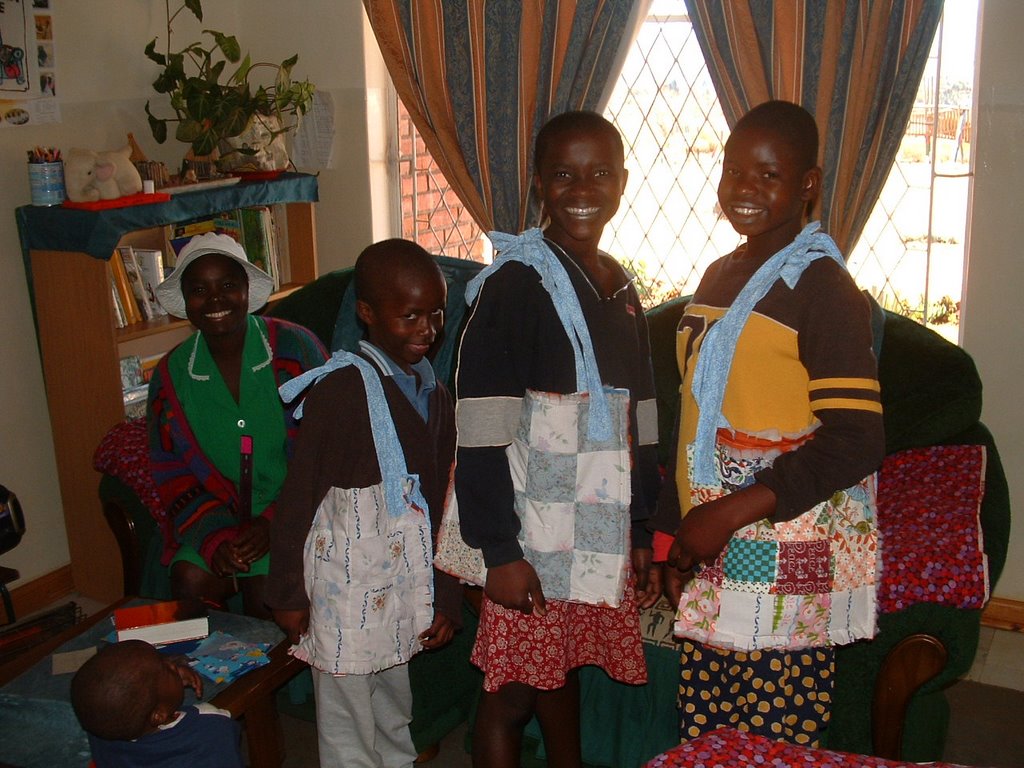
One of my more thrilling experiences at Old Mutare was seeing quilting skills that Annette taught expanding to a larger circle. Annette had passed on to Cecilia Mabvumbe of Fairfield Children’s Home some more advanced quilting skills, hoping Cecilia would also pass on her knowledge. Sure enough, within a few weeks, Cecilia had organized Fairfield housemothers for a regular Wednesday quilting class. Soon, they all were carrying quilted bags, and before long, some aunties had bags, too. (Click pictures for a larger view.)

Nyasha Mawayo, housemother in 8A where Annette and I are adopted grandparents, expanded the circle even further. Soon Nomatter and Justice, two of her older children, and their big sister, were sewing, too, and now, each had a bag in which to carry exercise books to Hartzell Central Primary School when the term begins September 5.

Friday, August 11, 2006

Cleopatra

For weeks, I had sought an opportunity to accompany Janine Roberts on one of her visits to farms near Old Mutare. At last, within a day of my leaving, that intention came true.

Janine directs a small, highly effective program called Hope of Zimbabwe from her home at Fairfield Children’s Home. Her mission is a simple one: reach out to people in need of care in the rural bush near Old Mutare. There is a medical component, caring for people suffering and dying of HIV/AIDS. There is also a childcare component, providing clothing and school fees to terribly needy children, many of them orphans. Janine came to Old Mutare two years ago to expand an informal effort by MaiChimba, one of the real heroes whom I was thrilled to meet and know. MaiChimba continues to work with Janine, and at present, an American volunteer, Melissa Maher, a student at Asbury Seminary, is working with Janine and MaiChimba as well.

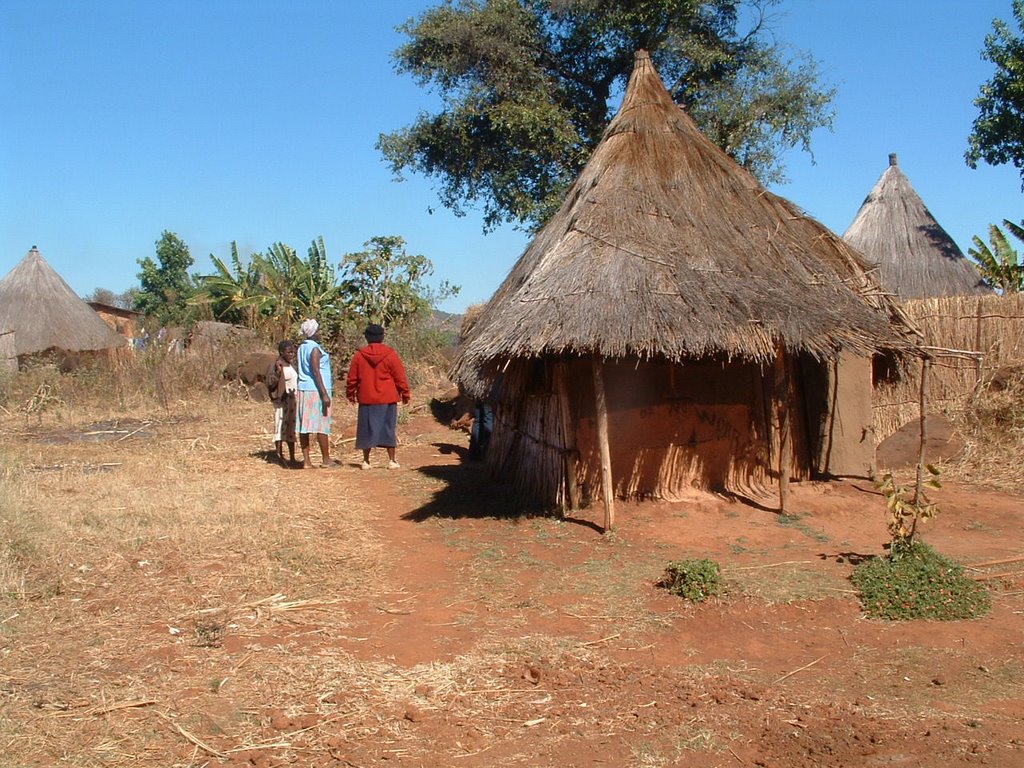
On Thursday at 1:00 p.m., we began a short trip by car to Miekles’ Farm, perhaps five kilometers from Fairfield Children’s Home, much of the trip on narrow, bumpy tracks through fields. Our destination was a cluster of thatch-roofed, clay-sided huts, 50 or more, scattered among fields but connected by well-worn paths. We began a trek among those houses, stopping at most of them to greet people. Children were everywhere. As we moved about, I quickly realized that although a mere stone’s throw from Old Mutare, the level of abject poverty I was seeing was unlike anything I had seen during my 13-week stay. I was amazed and shocked by what I saw—and puzzled that I had heard nothing about such intensity of need so close by.

Then I reminded myself, I had heard but had no experience by which to comprehend what I was hearing. MaiZvingo, the third-grade teacher in whose classroom I taught, had told me about the sorry living conditions of many of her students, and the headmaster, Shadreck Mufute, had shown me homes as we drove along roads far more distant, from which Primary School students come, walking many kilometers each way to school. Still, until I walked those pathways of Miekles’ Farm, I had no idea of the reality of their words. Now I knew, and it was distressing. How in the world can children learn when they must live with such utter deprivation?

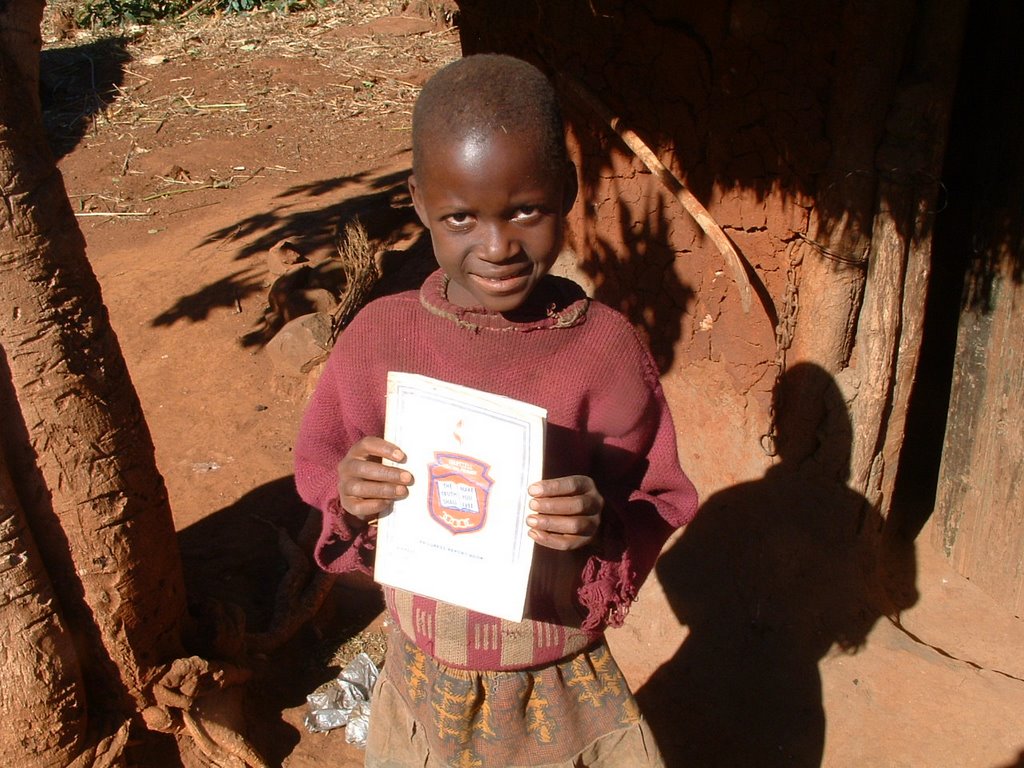
As we walked about, we came to the home of a grandmother raising her grandchildren (one of many in that hodgepodge of huts), both of their parents, her children, dead from AIDS. That grandmother, obviously quite old, leaned on a cane as she walked. English was not her forte, and she struggled to tell us what was on her mind. Soon, we figured out that she wanted us to meet her granddaughter and see her report card. She called Cleopatra from inside their hut, and she soon came out, clutching a familiar booklet with the logo of Hartzell Primary School on its cover, the report card she had received that morning when school closed.

Shyly, Cleopatra handed the booklet to Janine, then to me. I turned to the last completed page (report cards at Hartzell Primary follow the child through every grade, marks added at the end of each three-month term). It was obvious that she had done very well; her teacher’s comments were highly complimentary. I looked at the top of the page where her class standing was listed—number ONE in her class! Next to it, her standing in the entire third-grade—number TWO of at least 100 students. My eyes and mind turned to the pitiful surroundings in which I stood, in which Cleopatra was growing up. I looked at that little girl, now not in a neat school uniform but in tattered clothes she wore at home. I realized I was looking at a unique child for whom learning was a joy despite the misery of her environment. I saw a halo around that little girl’s head, although you will not spot it in her picture.

Of course, I realized that for everyone like Cleopatra, there were dozens who were not doing well, held back by the deprivation of daily life, the children MaiZvingo and Mr. Mufute care so much about. At the end of our trek among the houses, we returned to the car where Janine, MaiChimba and Melissa began to distribute clothing to a long line of orphans. Many more children, and a few grannies and other adults, stood by, watching as each child received two garments and a pair of shoes. Were they thinking that it was lucky to be an orphan? Every one of them could have used new garments, and all were shoeless, but there were not enough clothes for all. I was watching a prototype of what regularly happens in rural Africa, needs eclipsing remedies by far. Drops in a bucket? Or mustard seeds? The answer eludes me—but I will side with mustard seeds!

Wednesday, August 09, 2006

On the Ground in Portland

After sleeping through most of the last leg of my flight from Africa, I awakened Monday afternoon to look out the window and see a massive mountain just off the wingtip. Still drowsy, I wondered what had happened to cause the airplane to be so low and suddenly realized I was looking at Mt. Hood. Within minutes, we were on the ground and rolling to a stop. More than 36 hours earlier, I had boarded the flight from Harare to Jo'burg. Within a few hours, I was on a crowded airplane headed for Dulles airport where we landed 18 1/2 hours later, then a short hop to Atlanta before the final flight to Portland. Annette arrived Tuesday afternoon, so we are now at home in Portland, sorting out the many experiences and impressions of more than three months away.

I have left many good friends behind in a country that continues to experience incredible economc problems, making life difficult for everyone. Adding insult to injury, the Minister of Finance has announced revaluation of the currency, creating enormous confusion and resentment, and making exchange of foreign currency problematical. Inflation is now at about 100%/month. When I left Zimbabwe, money I changed early in my stay was worth about 1/4 as much. Petrol supplies are almost non-existent. Food costs are exorbitant, combining inflation and price gouging. For even the average Zimbabwean, living is tough.

Several projects will occupy me as I consider how I can continue to be involved in the lives and work of these good people. At the top of that list is a ten-year-old girl, whose name is Wayne Nyanungo, the daughter of a pastor. Wayne is more severely handicapped than anyone I have ever met. What can be done to reduce her suffering is way beyond me, but there must be some way to make a difference for her and her faithful family. I will try, working along with Rev. Kennedy Mukwindidza, a Zimbabwean pastor from Kansas, who initiated my visit with Wayne. I will soon post more information about Wayne, with pictures. Another project will assist a rural church, Marara, to complete the parsonage that has been half done for years, beyond the ability of that poor, small congregation to raise adequate funds. Follow this blog, and you will learn more soon.